

• Contact Us
  • About Us
Monday, August 24, 2026
  • Login
MetroBusinessNews
  • Home
  • Economy
  • Politics
  • News
  • Companies and Markets
  • Energy
  • Sports
  • Real Estate
No Result
View All Result
  • Home
  • Economy
  • Politics
  • News
  • Companies and Markets
  • Energy
  • Sports
  • Real Estate
No Result
View All Result
MetroBusinessNews
No Result
View All Result
ADVERTISEMENT
Home Economy

Moody’s Says Nigeria May Keep Multiple Exchange Rates Until 2020.

metro by metro
May 10, 2018
in Economy
0
Naira
0
SHARES
0
VIEWS

NairaNigeria will probably maintain its system of multiple exchange rates, which the International Monetary Fund has long-urged it to scrap, until at least early 2020, according to Moody’s Investors Service.
 Merging the naira’s various rates any sooner might force the government to weaken the currency and raise fuel prices, which would accelerate inflation, the ratings company said.
 Nigerian monetary and fiscal authorities are likely to wait until investments in oil refineries and fertilizer plants reduce Nigeria’s imports of petroleum products. While that may take another two years, it would put the government in a better position to stabilize fuel prices, which it caps at a level based on the central bank’s official naira rate, Moody’s said.
 If the government merges the exchange rates, “they won’t be able to provide discounted dollars to oil marketers.” Aurelien Mali, a sovereign analyst with Moody’s, said in an interview in Lagos on Wednesday. “ It means that either they have to increase pump prices or give subsidies to marketers, which would impact public finances. Neither option is credible at the moment.”

Despite being an OPEC member and Africa’s biggest oil producer, Nigeria imports nearly all its fuel because of the decrepit state of its refineries. It caps the gasoline price at 145 naira per liter ($0.48 at the official rate), which analysts say is below market costs.

Read Also

Nigeria’s Inflation Falls To 15.43 As Worries On Food Prices Remain

ICPC Uncovers N24bn Ghost Workers Scandal, Official Puts 14 Family Members On Government Payroll

ECOWAS Targets $294bn Climate Finance Gap, Moves To Unlock West Africa’s Carbon Market

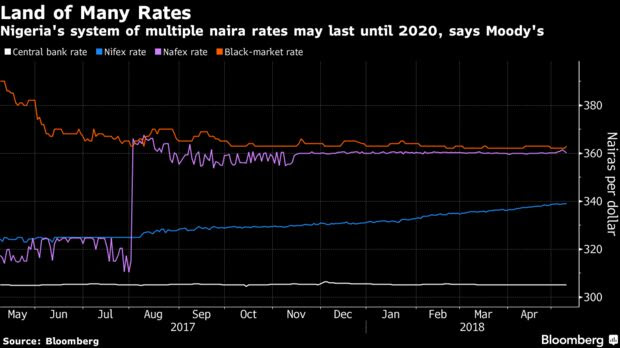
Central bank Governor Godwin Emefiele introduced the current foreign-exchange system in response to a severe shortage of dollars after the 2014 crash in oil prices. While the official exchange rate hasn’t changed from 305 per dollar since a devaluation in mid-2016, a new one for importers, exporters and investors was introduced in April last year, in which the naira was allowed to weaken. Known as the Nafex rate, it’s been steady at around 360 against the greenback, almost 20 percent weaker than the official rate.

There’s also the Nifex rate, which the central bank uses as a guide to sell dollars to banks during weekly auctions, and other windows that companies can access depending on the sector they’re in.

The IMF has said the existence of multiple exchange rates creates distortions in the economy and discourages foreign investment.

Inflation has slowed to 13.3 percent from a high of almost 20 percent in early 2017, thanks to an improving economy and tight monetary policy. Nigeria’s President Muhammadu Buhari has been keen to bring it down further before elections scheduled for February, when he plans to run for a second term. He’s loathe to raise gasoline prices, given that many Nigerians see cheap fuel as one of the few benefits they get from the government.

Increasing pump prices now would “destroy all the efforts” of the central bank on inflation, said Mali. “The moment you have a strong structural trade surplus and when the usage of dollars decreases is when we think they will align the exchange-rate windows. For example, when the new refineries or fertilizer plants are online.”

It’s unclear how the central bank will try to unify the naira, said Mali. But he expects that monetary officials will continue to manage instead of float it.

“The jury’s out on whether it will be 305 or 360,” he said. “For the real economy, the rate is already 360. That’s what many exporters, importers and manufacturers have to use. It’s the de facto exchange rate.”

The central bank’s strategy of imposing capital controls, including through import restrictions, should ensure that Nigeria’s foreign reserves keep rising, Mali said. Already up 55 percent in the past 12 months to $48 billion as oil prices and portfolio inflows have increased, he sees them at $55 billion by the end of the year.

Bloomberg.

Tags: Multiple Exchange RatesNaira
Previous Post

Dogara implores EFCC to improve anti-corruption fight

Next Post

Forte Oil emerges sole distributor of Texaco lubricants

Related Posts

More Nigerians Go Hungry As Food Prices Soar beyond Average Consumers
Economy

Nigeria’s Inflation Falls To 15.43 As Worries On Food Prices Remain

August 17, 2026
ICPC Arrests NSCDC Deputy Commaandant Over Alleged N3bn Fraud
Economy

ICPC Uncovers N24bn Ghost Workers Scandal, Official Puts 14 Family Members On Government Payroll

August 13, 2026
Leadership Deficit And Political Crises Rocking ECOWAS Region
Economy

ECOWAS Targets $294bn Climate Finance Gap, Moves To Unlock West Africa’s Carbon Market

August 12, 2026
Debt Crisis Hits New Highs In Developing Nations, Relief Deal Needed, Says UN
Economy

Amid Rising Revenue FCT, Lagos, Rivers Aaccount For 43% Of Nigeria’s N4.52trn States’ Debt

August 10, 2026
Next Post

Forte Oil emerges sole distributor of Texaco lubricants

Rwanda Highlights Potential for Migration to Drive Jobs, Skills and Regional Growth: IOM Chief

August 21, 2026
UK Finance Minister Says Govt To Cut Cost By 15%

Democratic California State Legislator Wahab Wins US House Of Representatives Seat

August 21, 2026
FG considers foreign exchange reforms as dollar shortages bite

Dollar Wobbles As Investors Balk At US Treasury’s Rescue Efforts

August 21, 2026
MetroBusinessNews

© 2022 Metro Business News

Navigate Site

  • Contact Us
  • About Us

Follow Us

Welcome Back!

Login to your account below

Forgotten Password?

Retrieve your password

Please enter your username or email address to reset your password.

Log In
No Result
View All Result
  • Home
  • Economy
  • Politics
  • News
  • Companies and Markets
  • Energy
  • Sports
  • Real Estate

© 2022 Metro Business News

Go to mobile version