

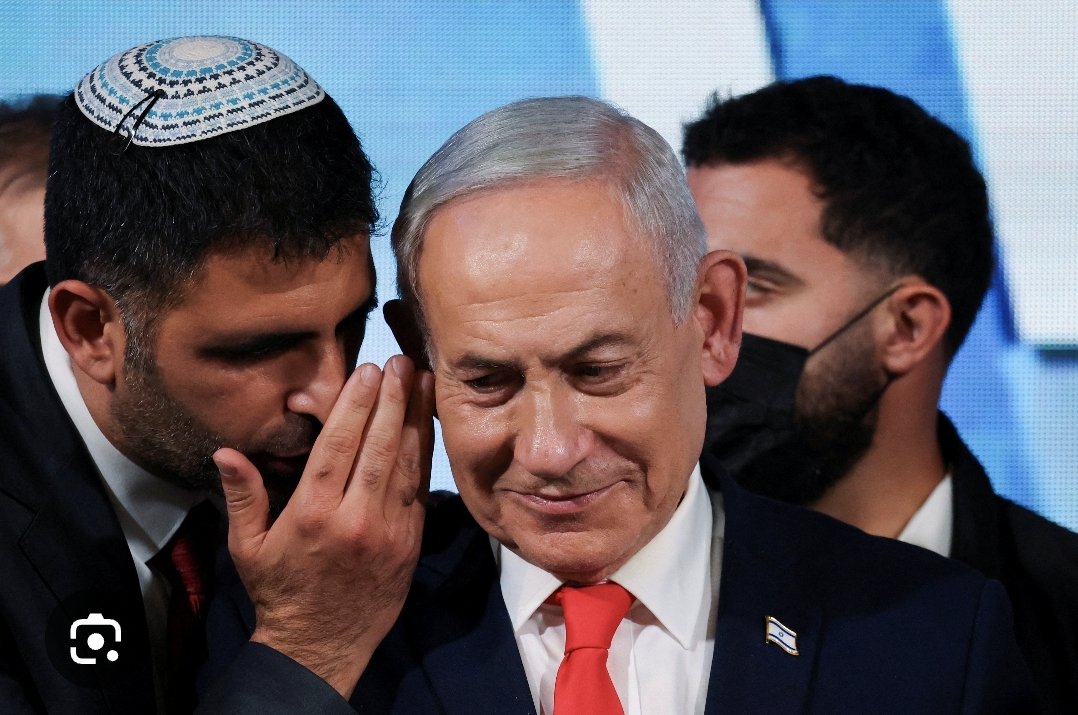
Benjamin Netanyahu won the support of an unexpectedly clear majority of Israeli Jews in an election billed as a major turning point in his nation’s history, apparently ensuring he will survive as prime minister at least in a caretaker role.
With around 70.7% of votes tallied on Wednesday morning, Israeli media forecast Netanyahu’s bloc of right-wing, far-right and ultra-Orthodox parties winning 54 seats in parliament, far surpassing 47 for the opposition bloc of rival Gadi Eisenkot. Parties representing Israelis of Arab descent would win 19.
The results could still change as counting continued, but a victory for Eisenkot appeared increasingly out of reach, as his bloc of anti-Netanyahu parties from centre-left to hard-right underperformed pre-election polls that forecast a tight race.
While Netanyahu lost his bloc’s majority in the 120-seat Knesset, as expected, opponents were left with no hope of unseating him without some form of backing of Arab parties, which many have ruled out. Even then, he would remain as caretaker during any coalition negotiations, or until a new election next year.
SECURITY FIGHT SHARPENS
Netanyahu, addressing his Likud party’s faithful after 3 a.m. (0100 GMT) at the party’s election headquarters in Jerusalem, called for the formation of “a strong, right-wing national government”.
He also highlighted Israel’s military successes and raised the prospect of renewed joint military action against Iran alongside his ally, US President Donald Trump.
“Israel faces a singular historical opportunity, together with our partner President Trump, to remove the existential threat of Iran once and for all. But ulterior motives must not divert us from this sacred mission,” he said.
READ ALSO:Outrage As Nigeria Panel Says 37 Detained Miners Died From Overcrowding, Neglect
Trump, who had called on Israeli voters to keep Netanyahu in power so they could “finish the job” in Iran, said Netanyahu had done “very well” thanks to his own endorsement.
“I think when the endorsement went out, it helped him a lot, but I actually heard he did pretty well. It might be winning or tie. The tie is sort of considered a win in that case because it’s a big chess match,” Trump said early on Wednesday at a campaign stop in Texas.
EISENKOT CALLS ON SECURITY CHIEFS TO RESIST PRESSURE
Eisenkot acknowledged that Netanyahu was still in office as a caretaker, but said the prime minister had lost public support and urged him to retire from politics. He also issued a warning that Netanyahu might use security for political ends.
“I call on the heads of the security establishment and the civil service: Netanyahu is a caretaker prime minister, without a mandate or the people’s trust,” he said.
“Remember that you serve only the state and the interests of Israel’s citizens. Stand firm in the face of any attempt to challenge you. You have my unequivocal backing. Netanyahu, do not dare use Israel’s security for your political needs.”
The election was the first held in Israel since Hamas-led fighters killed 1,200 people and carried off 251 hostages in attacks that shattered the country’s sense of security and plunged it into war in Gaza, Lebanon and Iran.
The war in Gaza, which flattened the territory and killed 74,000 Palestinians, has left Israel increasingly isolated on the world stage, with a decisive shift in global public opinion against it, including in its closest ally the United States.
Netanyahu himself is wanted by the International Criminal Court in The Hague on war crimes charges he calls absurd, and faces corruption charges in Israel that he dismisses as an establishment plot.
DECISIVE SHIFT IN ISRAELI POLITICS
His continued support from most Israeli Jews was a clear sign of the decisive shift in Israeli politics that he has presided over as the dominant political figure of the era.
His brand of unapologetic Jewish nationalism, support for settlement on occupied Palestinian land and contempt for all foreign criticism is now firmly entrenched as the Israeli mainstream.
The centre-left that dominated Israel for the first half of its history and had led negotiations to exchange land for peace with Arab neighbours has been reduced to a small fringe.
Nearly all Jewish parties now share Netanyahu’s rejection of any eventual independent state for Palestinians, the basis of internationally endorsed peace talks since the 1990s, when he first came to power as Israel’s youngest-ever leader.
After a spell in the wilderness as a right-wing maverick, he returned to power in 2009 and has remained ever since, apart from a period of 18 months when a rickety coalition of opponents managed to lever him out after four inconclusive elections in two years.
Both sides saw Tuesday’s election as a decisive turning point for the nation, driving turnout to 77.7%, the highest in more than two decades and around 7 percentage points higher than in 2022.
Turnout was particularly high among Israelis of Palestinian descent, who make up more than a fifth of the population but whose representatives have historically been excluded from the cabinet. Many were motivated by what they see as open racism from Netanyahu’s cabinet, which includes a party leader convicted of inciting racial hatred against Arabs.
The headquarters of the Joint List, an alliance of several Arab parties, burst into whistles and applause when exit polls were released.
“We refuse the occupation and racism, and we will remain here,” said Faten Gattas, a candidate in the Joint List, in a speech at the alliance’s headquarters in Nazareth.