

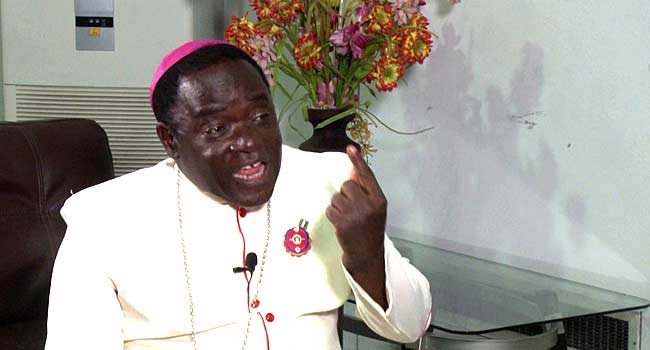
The Bishop of Sokoto Diocese, Matthew Kukah, has called on political leaders to ensure that Nigerians experience measurable improvements in their quality of life, stressing that citizens must see tangible benefits from their participation in elections.
Kukah spoke to Channels Television on Tuesday in Abuja before the signing of the National Peace Accord ahead of the 2027 general elections.
“Ordinary Nigerians need to see a qualitative and measurable improvement in the quality of their lives. We are not just handing you our votes and then you take the votes and run with them,” he said.
The bishop also urged Nigerians to become more actively involved in the electoral process, stressing that the responsibility for credible elections should not be left entirely to the Independent National Electoral Commission (INEC).
“I think that critical to all of this is the need to sensitise ordinary citizens. I think we often underrate the capacity of the ordinary citizen,” Kukah said.
He noted that while INEC is responsible for conducting elections, citizens also have a role to play by understanding the electoral process, knowing their rights and responsibilities, and contributing to the credibility of elections.
Kukah expressed optimism that technology could help strengthen the electoral process and reduce manipulation.
“I see a lot of hope and a lot of future in terms of technology because the truth of the matter is that manipulation from the Latin word manus, that is hand, anything that you are holding with your hand is subject to manipulation. And once all of this goes to science and technology, even the criminal becomes helpless,” he said.
READ ALSO:’We Respect The process’:Oyebamiji Endorses APC Review Of Osun Election Result
‘Politics Is A Noble Game’
The bishop also urged politicians to see public service as an opportunity to improve the lives of citizens rather than merely pursue personal interests.
“I keep telling our politicians, ‘Politics is a noble game.’ You can create a bit of nobility around it, but we didn’t vote for you to be happy on our behalf,” he said.
According to Kukah, public confidence in democracy will grow when Nigerians can see clear evidence that their lives are improving.
“People’s confidence will increase as long as they can see a mirror image of the fact that their lives are changing,” he said.
He added that Nigeria’s continued practice of democracy decades after the return to civilian rule demonstrates that ordinary Nigerians remain committed to the democratic system.
“I think the very fact that we are having all these elections, 27 years later, and we are still here is a clear testimony that Nigerians, ordinary people, love democracy. But the challenge for the ruling class is to reward them, and you reward them by doing good and making them trust the system,” Kukah said.
The National Peace Committee, led by former Head of State General Abdulsalami Abubakar, facilitated the signing of the first National Peace Accord for the 2027 general elections in Abuja on Tuesday.
The accord seeks to commit political parties and their candidates to issue-based campaigns and peaceful conduct before, during and after the elections.
The National Peace Committee was established ahead of the 2015 general elections to promote peaceful elections, mediate political disputes and encourage political actors to accept electoral outcomes.
The 2015 peace accord, signed by then-presidential candidates Goodluck Jonathan and Muhammadu Buhari, preceded Nigeria’s first democratic transfer of power from an incumbent ruling party to an opposition party since the return to democracy in 1999.
The initiative has since been extended to several off-cycle governorship elections across the country.