

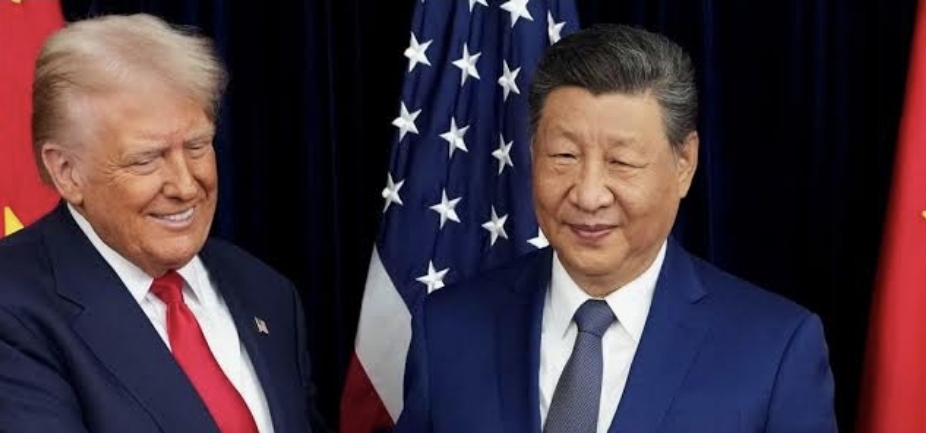
China reiterated its strong opposition to United States arms sales to Taiwan on Wednesday, urging Washington to honour its commitments as president Xi awaits Donald Trump for a high-stakes summit with Chinese President Xi Jinping.
Few hours after the fresh warning from China, Donald Trump and an entourage that included Nvidia’s Jensen Huang and Elon Musk arrived China and were greeted with a lavish welcome in Beijing .
Sources say Trump has prepared to ask China’s Xi Jinping to “open up” to U.S. business at the start of their two-day summit.
Trump is seeking to snag some economic wins on the first visit by a U.S. president to China in nearly a decade and maintain a fragile trade truce to prop up public approval ratings bruised by his war with Iran.
He was welcomed by Chinese dignitaries, a tightly choreographed formation of military honor guard and dozens of Chinese students waving U.S. and Chinese flags as he disembarked Air Force One in the waning hours of twilight on Wednesday.
Pausing midway down the red carpet as the students chanted “welcome, welcome, warm welcome” in Mandarin, he punched the air and smiled broadly before departing in his limousine.
The CEOs accompanying Trump are drawn mainly from companies seeking to resolve business issues with China, such as Nvidia, which has struggled to get regulatory permission to sell its powerful H200 artificial intelligence chips there.
Trump asked Huang at the last minute to join the trip, said a source familiar with the matter who spoke on condition of anonymity, and he was spotted boarding Air Force One during a refuelling stop in Alaska en route to Beijing.
“I will be asking President Xi, a Leader of extraordinary distinction, to ‘open up’ China so that these brilliant people can work their magic,” he said in a post on Truth Social, referring to the CEO delegation.
“I will make that my very first request.”
Asked about Trump’s post, Guo Jiakun, a spokesperson for China’s foreign ministry, said Beijing stands ready to “expand cooperation, manage differences and inject more stability and certainty into the turbulent world”.
As Trump prepared for the pomp-filled occasion, his trade negotiator Scott Bessent wrapped up three hours of preparatory talks with Chinese officials in South Korea.
China’s official Xinhua news agency described them as “candid, in-depth and constructive”, but officials did not offer any detailed summary.
Trump’s two days of meetings will include a grand reception at The Great Hall of the People, a tour of Beijing’s 600-year-old Temple of Heaven imperial religious complex, and a state banquet.
Apart from trade, the talks will cover a host of sensitive subjects from the Iran war to U.S. arms sales to Taiwan, the democratically governed island claimed by China.
Trump is widely expected to encourage China to convince Tehran to make a deal with Washington to end the conflict, though he has said he did not think he would need its help.
China reiterated on Wednesday its strong opposition to U.S. arms sales to Taiwan, with the status of a $14 billion package awaiting Trump’s approval still unclear.
The United States is bound by law to provide Taiwan with the means to defend itself, despite a lack of formal diplomatic ties.
China regards the democratically governed island as part of its territory.
BESSENT PREPS IN SOUTH KOREA
While Trump rubbed shoulders with executives aboard Air Force One, Bessent held his latest round of trade negotiations with Chinese Vice Premier He Lifeng at a VIP reception room at South Korea’s Incheon airport.
The talks ran about three hours to end just before 4 p.m. (0700 GMT), a U.S. official said.
The two sides are eager to maintain a truce struck last October in which Trump suspended triple-digit tariffs on Chinese goods and Xi backed away from choking global supplies of rare earths, vital in making items from electric cars to weapons.
They are also expected to discuss forums to support mutual trade and investment and dialogue on AI issues, while Washington looks to sell Boeing airplanes, farm goods and energy to China to cut a trade deficit that has long irked Trump, U.S. officials have said.
Beijing, for its part, wants the U.S. to ease curbs on exports of chipmaking equipment and advanced semiconductors.
Trump enters the talks with a weakened hand.
Courts have hemmed in his ability to levy tariffs at will on exports from China and other countries.
The Iran war has also boosted inflation at home and escalated the risk that Trump’s Republican Party will lose control of one or both legislative branches in November’s midterm elections.
Though the Chinese economy has faltered, Xi does not face comparable economic or political pressure.
“The Trump administration needs this meeting more than China does, as it needs to show to American voters that deals are signed, money is made,” said Liu Qian, founder and CEO of Wusawa Advisory, a Beijing-based geopolitical advisory firm.
While Trump has lauded his personal rapport with Xi and respect for China, several Beijing residents told Reuters they viewed his visit with a mixture of hope and suspicion.
“I don’t know if he’s genuinely sincere,” Lou Huilian, a 44-year-old who works in the oil trade, said outside a metro station as she headed to work on Wednesday.
“But speaking as a Chinese person, and as someone working in trade, I just hope some good policies can come out of this.”
However, the issue of Taiwan, which China regards as part of its territory, alongside U.S. weapons sales to Taipei, was expected to feature prominently in the two-day talks between both leaders.
The United States, under its domestic law, has been required to provide Taiwan with defensive capabilities despite lacking formal diplomatic relations. In December, the Trump administration announced an $11 billion arms package for Taiwan, marking the largest such deal to date.
Zhang Han, a spokesperson for China’s Taiwan Affairs Office, said Taiwan remained an internal matter for China and stressed Beijing’s firm stance against any form of US-Taiwan military cooperation.
She said China “firmly opposed” US arms sales and military ties with Taiwan, describing the position as consistent and unequivocal.
Zhang added that Taiwan represented the “core of China’s core interests” and argued that US commitments on the issue were international obligations that Washington was duty-bound to fulfil.
While the United States maintained its “One China” policy and took no formal position on Taiwan’s sovereignty, it continued to acknowledge Beijing’s claim over the island.
Trump’s visit came less than a week after Taiwan’s opposition-led legislature approved only two-thirds of a proposed $40 billion special defence budget requested by President Lai Ching-te, cutting several domestic defence programmes while still funding US arms purchases.
A senior US official said Washington had been disappointed with the reduced defence allocation, arguing it fell short of expectations.
A Taiwanese security official warned that Beijing could use the budget reduction as leverage during discussions with Trump, potentially arguing that Taiwan itself was unwilling to prioritise arms purchases.
Reports also indicated that a further $14 billion arms package could be considered after Trump’s China visit, although its approval status remained unclear.
President Lai, speaking at the Copenhagen Democracy Summit, described Taiwan as a sovereign, independent democracy that would not bow to external pressure.
In response, Zhang insisted Taiwan was an inseparable part of China and would “never be a country,” adding that Beijing’s resolve to oppose Taiwan independence remained firm.
A spokesperson for Lai’s Democratic Progressive Party said Taiwan’s government, military, and democratic system demonstrated its sovereignty, adding that the island would continue to assert its international presence.