


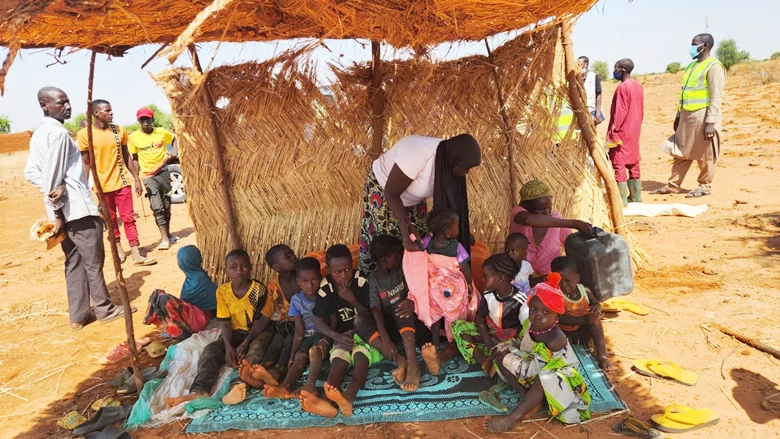
Washington, USA, 03 April 2026 -/African Media Agency (AMA)/- Community-built shelters in Niger are enabling mothers to participate in land restoration work by providing shaded spaces for their children, protecting them from extreme heat and environmental hazards.
The initiative has led to the construction of 662 shelters across six regions, safeguarding 6,465 children and allowing women to focus on earning income and supporting their families.
This practical solution not only improves household livelihoods but also advances women’s economic empowerment, transforming a structural barrier into a pathway for resilience and community development.
The Issue: An impossible choice
In the sun-scorched landscapes of Niger, where temperatures can reach 45°C (113°F), a quiet but powerful shift is underway. It’s not just about restoring the land—it’s about enabling the women who sustain their families and communities to work safely and earn an income. A simple, community-built shelter has helped remove a barrier that kept many mothers from participating in land restoration: childcare in extreme heat.
In 2023, the Integrated Landscape Management Project (PGIP), an environment and natural resources management project financed by the World Bank through IDA credit, launched a large Cash for Work program to help rural communities restore degraded lands and build resilience to climate change. As implementation moved forward, the team saw a human hurdle: women with young children faced an impossible daily choice. Formal childcare options were scarce. Many mothers brought infants and toddlers—some as young as one year old—to the worksites, exposing them to intense sun, dust, and high winds. The risks ranged from dehydration to insect and snake bites. Mothers worried about safety and health, and their participation—and earnings—suffered.
The Solution: Community-built shelters (“hangars”)
The team listened to women and worked with local leaders to test a practical, culturally rooted solution: build shaded shelters near worksites and ask trusted “village grandmothers” to supervise the children. These hangars use local materials—wooden poles, straw, and planks—and create cool, protected spaces where children can rest and play while their mothers work nearby. Community selection of elder caregivers created trust and accountability, while keeping the model simple, affordable, and easy to maintain.
The Impact
Immediate and transformative results came quickly. To date, 662 shelters have been built across six regions, providing safe spaces for 6,465 children. By removing a basic barrier—safe childcare in extreme heat—the project unlocked women’s participation in cash-for-work activities and helped stabilize household incomes. Communities report greater peace of mind for mothers and better focus on work when children are safe and close by.
Community-built shelters are playing a pivotal role in advancing Niger’s job agenda by removing a critical barrier to women’s participation in land restoration work. By providing safe spaces for childcare, these shelters allow mothers to take part in Cash for Work programs, increasing the workforce and directly supporting household incomes. This access not only expands employment opportunities for women but also enhances their ability to contribute economically to their families and communities.
The initiative fosters skills development and community cohesion. As women are freed from the constraints of childcare during working hours, they can engage more fully in restoration activities, gaining practical experience and confidence. This strengthens their position in the labor market and promotes broader inclusion, making access to jobs more equitable and sustainable for rural communities.
Governance and sustainability
To sustain the model, existing village structures—Site Management Committees (COGES) and Grievance Redress Committees (CGP)—handle logistics, upkeep, and any concerns. This light-touch governance reinforces community ownership and keeps the shelters practical and responsive.
What’s next: Adapting and improving
The project is developing mobile shelters—lightweight, detachable units that can move with worksites as activities shift seasonally. These will remain cost-effective and compliant with environmental and social standards, with attention to child health and safety. Existing shelters will be upgraded with mats, simple toys, picture books, and water trays, making the spaces more comfortable and stimulating. “Village grandmothers” will receive basic training in child protection, hygiene, and caregiving to strengthen care quality without complicating the model.
This is a straightforward lesson in inclusive development: when we remove everyday social barriers, climate and livelihoods projects go further. In Niger’s heat, childcare became the decisive factor in women’s participation. A low-cost, community-led solution turned a risk into a result—protecting children, increasing women’s earnings, and improving the effectiveness of land restoration.
Beyond one project, the hangar model offers a practical blueprint for public works and climate resilience operations. It shows how integrating simple social measures—from trusted caregivers to grievance channels—can elevate outcomes and expand who benefits, especially in contexts of extreme heat and limited services.
This approach is affordable, replicable, and rights-respecting. Most importantly, it helps women work safely and earn, while children stay protected—an inclusive path to climate resilience that can be scaled.
Distributed by African Media Agency (AMA) on behalf of Word Bank Group.
This initiative is part of the Integrated Landscape Management Project (PGIP), which is part of the Sahel RESILAND Program and is implemented by the Government of Niger with the technical and financial support of the World Bank, PROGREEN, and PROBLUE.
The post How community shelters protect children and help women restore degraded lands in Niger appeared first on African Media Agency.