

*As Nigeria’s 36 states share N4.43Tn in 7 months
The unbridled propensity to share the nation’s wealth by the government at the centre and the units monthly has continued to promote fiscal laziness as well as fiscal imbalance among the federating units.
Also, the derivation principle, which grants 13% of oil and gas revenue to producing states, has perpetually kept some states ahead of others and as well ensured that petroleum revenue remains the main source of government funding, at the expense of the mouthed diversification.
Specifically, Nigeria’s 36 states shared a cumulative N4.43 trillion from the Federation Accounts Allocation Committee (FAAC) between January and July 2025, with receipts of oil-rich states accounting for about 35% of total disbursements, according to Nairametrics
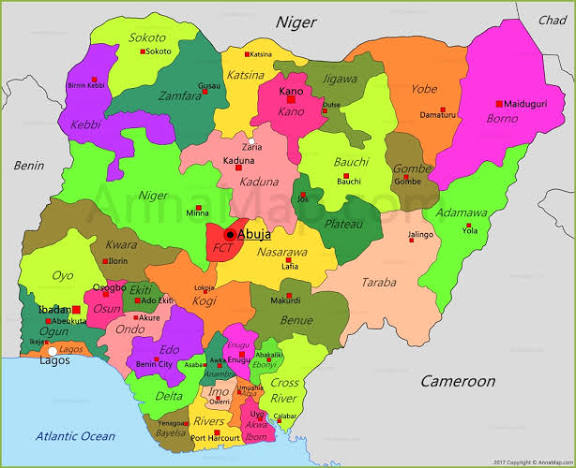
Data from the National Bureau of Statistics (NBS) and FAAC reports show that Delta State received the highest net allocation during the period—N361.23 billion—followed closely by Rivers (N301.18 billion), Lagos (N279.03 billion), Akwa Ibom (N278.11 billion), and Bayelsa (N274.81 billion).
These top five states alone accounted for nearly 35% of the total FAAC disbursement to all states within the seven-month period.
More worrisome, according to the analysts is the fact that they are no complimentary visible projects, even as some of the state capitals have no good roads and other infrastructure.
Most Nigwrians say 4he subsidy removal was more beneficial to the Chief executives of the various states, who are believed not to be accountable to any institutions, as most of the Houses of Assembly are more like extensions of the executive arm of government
Consequently, the analysts say the derivation principle brings about fiscal imbalance, even as the citizens continue to clamour for restructuring
Indeed the NBS data has brought about renewed attention to Nigeria’s long-standing debate over fiscal federalism to discourage the states from relying on Abuja for monthly disbursements rather than building sustainable local economies.
“ It is rather unfortunate that states continue to behave like administrative outposts rather than economic entities, and the ’emperors’ who have unlimited powers, have dropped their thinking caps since funds come from Abuja every month,” says an analyst.
Also, he noted that the distribution of FAAC funds has rekindled the argument for economic restructuring and resource control, an argument that has since been politicised with stronger centre opposing while lazy states have abandoned the abundant natural and human resources that should have been properly harnessed to enhance their internally generated revenue, (IGR).
“Fiscal federalism is all about allowing states to retain a higher share of revenues generated internally as we had when the country was being governed on regional basis and this could spur competition, innovation, and accountability. Unfortunately, this remains alien to our leaders as impunity reigns supreme in all aspects of the nation’s life,” says another analyst.
READ ALSO:Amid Rising States’ Indebtedness, IMF Raises Nigeria’s 2025, 2026 Economic Growth Projections
According to Friday Ameh, Lagos based energy analyst, ” the much touted fiscal stability of the country depends, not on how much FAAC distributes but on how efficiently the states manage their economies using the human resources and technology.”
Speaking further, he said sustainable subnational economies will depend on how well states diversify their revenue bases, strengthen governance, and reduce overreliance on federal allocations.
At the bottom of the distribution were
Ekiti (N70.83 billion); Ogun (N67.20 billion).
While Delta’s N361.23 billion leads the pack, the analysts note that the state’s high receipts are largely tied to oil derivation payments, not internally generated revenue (IGR).
Similarly, Rivers and Akwa Ibom, both key crude-producing states, benefited heavily from derivation inflows and value-added tax (VAT) returns from industrial activities within their jurisdictions.
Lagos Retains Edge Among Non-Oil States
Lagos State, Nigeria’s commercial nerve centre, stood out as the highest-earning non-oil-producing state, receiving N279.03 billion in seven months.
The bulk of its FAAC receipts came from VAT and statutory allocations, in addition to its own robust IGR base estimated at over N400 billion annually.
Economists say Lagos’ performance reinforces the importance of economic diversification at the subnational level.
Northern States Lag Behind
Despite its huge population, northern states collectively received smaller shares of the FAAC pie.
Kano, the most populous northern state, ranked sixth overall with N149.81 billion, while Katsina (N109.31 billion), Borno (N110.00 billion), and Jigawa (N106.87 billion) trailed far behind the oil-rich southern states.
Most northern states rely almost entirely on federal transfers to fund their budgets.
Analysts warn that the gap between resource-rich and resource-poor regions could further widen with the implementation of government new fiscal reforms.
Middle-Belt, Southeastern States Show Modest Gains
States in the Middle Belt, notably;
Benue (N104.58 billion); Niger (N97.38 billion); Kogi (N95.20 billion),
These states maintained mid-range allocations, driven by their contributions from solid minerals and agriculture.
Meanwhile, southeastern states such as Anambra (N111.85 billion), Enugu (N92.71 billion), and Abia (N98.12 billion) received moderate disbursements.
The Southeast’s relatively lower allocations highlight low federal allocation and the need to increase IGR