

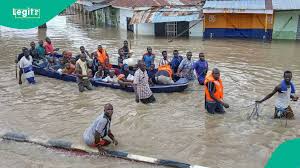
The Federal Government has warned of a potential flooding in 198 local government areas across 30 states and the Federal Capital Territory.
The flood alert was issued by the Nigeria Hydrological Services Agency (NiHSA) on Thursday
According to the agency, the alert covers the period from August 7 to August 21, 2025, a span of 15 days, during which vulnerable communities are advised to take precautionary measures.
The alert categorised flood risk levels as very high, high, and moderate, depending on local topography and projected rainfall intensity.
The very high-risk states are Adamawa, Bauchi, Bayelsa, Benue, Borno, Delta, Gombe, Kebbi, Kogi, Lagos, Niger, Ogun, Rivers, Yobe, and Zamfara.
States categorised as facing high to moderate risk include Akwa Ibom, Anambra, Cross River, Ebonyi, Edo, FCT, Imo, Jigawa, Kaduna, Kwara, Nasarawa, Ondo, Plateau, Sokoto, and Taraba.
The agency also disclosed that over 832 communities are at risk of varying degrees of flooding.
READ ALSO:Trump Signs Memo Requiring Universities To Disclose Admissions Data On Race
The statement revealed that over 100 major transportation routes are to face possible disruptions, and high likelihood of displacement, especially, in low-lying and flood-prone areas.
Director General of the agency, Umar Mohammed said: “NiHSA urges residents in affected regions to remain vigilant, adhere to early warning directives, and cooperate with emergency response agencies.
“This alert is issued in line with our commitment to safeguarding lives and property.”
He also appealed to affected states and local governments to rise up to the occasion and safeguard the lives of their people.
“We call on state governments, local authorities, and the public to take proactive measures to mitigate risk and ensure community safety,” Mohammed said.
He assured that the agency will continue to monitor the hydrological situation and provide timely updates as necessary.
He also added that for further information and real-time flood updates, citizens are encouraged to follow NiHSA’s official channels or contact their respective State Emergency Management Agencies, SEMAs.