

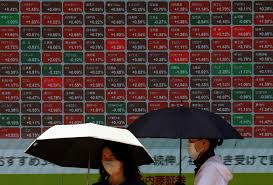
Global shares remained in the red on Friday after weaker than expected U.S. jobs data prompted markets to add to rate cut bets from the Federal Reserve, following earlier losses sparked by U.S. President Donald Trump’s latest tariffs salvo.
Nasdaq futures and S&P 500 futures were down about 1% after the data, broadly in line with where they were before the release.
Sign up here.
The pan-European STOXX 600 fell 1.4%, taking its weekly fall to about 2% and putting it on track for its biggest weekly drop since Trump announced his first major wave of tariffs on April 2.
The U.S. economy added 73,000 nonfarm payrolls last month, below expectations for 110,000 in a Reuters survey of economists. The unemployment rate ticked up to 4.2%.
“There’s no way to pretty-up this report,” said Brian Jacobsen, chief economist at Annex Wealth Management.
“Last year the Fed messed up by not cutting in July so they did a catch-up cut at their next meeting. They’ll likely have to do the same thing this year.”
Money market traders added to bets for a rate cut from the Fed at its September meeting.
Markets imply around a 90% chance of a rate cut next month, compared with about 45% before the jobs data, according to LSEG data.
The softer labour market figures arrived a day after Trump signed an executive order imposing tariffs ranging from 10% to 41% on U.S. imports from several major trading partners.
Rates were set at 25% for India’s U.S.-bound exports, 20% for Taiwan’s, 19% for Thailand’s and 15% for South Korea’s.
He also increased duties on Canadian goods to 35% from 25% for all products not covered by the U.S.-Mexico-Canada trade agreement, but gave Mexico a 90-day reprieve from higher tariffs to negotiate a broader trade deal.
“The August 1 announcement on reciprocal tariffs is somewhat worse than expected,” said Wei Yao, research head and chief economist in Asia at Société Générale.
MSCI’s broadest index of Asia-Pacific shares outside Japan (.MIAPJ0000PUS) fell 1.5%, bringing the total loss this week to roughly 2.7%.
Japan’s Nikkei (.N225) closed 0.7% lower, Chinese blue chips (.CSI300) ended 0.5% down and Hong Kong’s Hang Seng index (.HIS) lost more than 1%.
READ ALSO:Trump Hits Dozens Of Countries’ Goods With Steep Tariffs
The U.S. dollar had earlier found support from fading prospects of imminent U.S. rate cuts, but reversed course after the data.
The dollar index , which measures the currency against six others, was last down 1% on the day.
The yen had weakened past 150 per dollar for the first time since April but strengthened to 148.71 per dollar after the data.
The Bank of Japan held interest rates steady on Thursday and revised up its near-term inflation expectations, but Governor Kazuo Ueda sounded a little dovish in the press conference.
Two-year Treasury yields , which are sensitive to changes in interest rate expectations, dropped 17.5 basis points to 3.7761%. Benchmark 10-year yields slipped 9 basis points to 4.273%.
In commodity markets, oil prices continued to fall after a 1% plunge on Thursday. Brent dipped 0.3% to $71.55 per barrel, while U.S. crude fell 0.1% to $69.22 per barrel.
Spot gold rose 1.3% to $3,332 an ounce.
This range plot displays U.S. President Donald Trump’s tariff rates, compared to the most recent previously announced or threatened tariff rates, for the U.S.’s trading partners on Aug. 1, 2025