

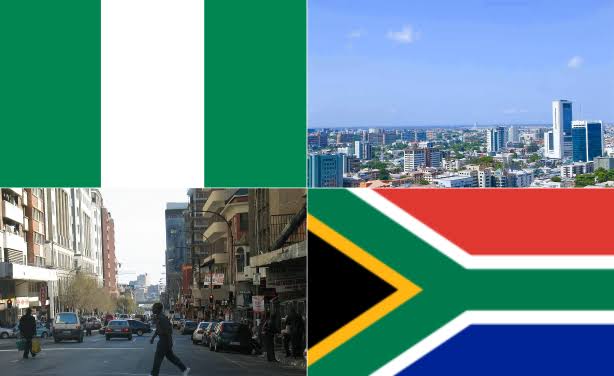
John Danjuma Omachonu
South Africa’s consumer price inflation eases to 2-year low of 4.7 percent, more-than-expected in July, the lowest level in two years, largely due to a slowdown in food prices and cheaper transport charges, figures from Statistics South Africa showed on Wednesday.
The development has posed leadership burden on Nigeria, the largest African economy with 24 percent in July.
More striking with the Nigerian economy is that the month-on-month inflation measure, which when annualized, jumped to 40.77 percent.
But, Nigeria maintained the position of the largest economy on the African continent for the fifth consecutive year in 2022, with a nominal GDP of $477.4 billion.
The giant of Africa, as it is mostly referred to, accounted for 17.4% of the African economy in the review year ($2.7 trillion).
This is according to data by the World Bank. Nigeria has topped this list since 2018 when it overtook South Africa as the largest African economy.
According to the World Bank, Nigeria’s economy grew by 8.3% year over year in 2022 from $440.8 billion recorded in the previous year.
Though Nigeria is ranked top on Gross Domestic Products (GDP), worth $477.38 billion, South Africa with lower GDP of $405.71 billion, is far more developed, with good infrastructure and banks, and a diverse and sophisticated economy.
While the economy of South Africa is the most technologically advanced, and diversified economy in Africa with lower inflation rate, Nigeria’s headline inflation maintained its runaway trend again in July, rising sharply by 1.29% to 24.08%, the seventh consecutive monthly increase and the highest inflation rate in 18 years.
In fact, the monthly inflation is a more accurate reading of inflation expectations and is a major red flag for policy-makers.
The steep rise in consumer price inflation largely reflects the impact of recent policy changes on food and transport costs.
Food inflation rose sharply by 1.73% to 26.98%.
However, the commodities that spiked the most were oil and fat, bread and cereals, fish, potatoes, yam and other tubers, fruits, meat, vegetable, milk, cheese, and eggs.
Another noticeable trend is the rural-urban inflation gap, which widened to 3.34% from 1.01% in June, largely reflecting the impact of higher logistics costs on commodity prices.
The price of diesel, a major fuel used by trucks for food distribution and logistics surged by 18.06% to N850/ltr due to naira depreciation and the 7.5% VAT.
ALSO READ:Prigozhin: Russia’s Mercenary Supremo Turned Kremlin Enemy
South Africa, on the other hand, is an upper-middle-income economy, one of only eight such countries in Africa.
Specifically, the consumer price index, or CPI, rose 4.7 percent year-on-year in July, slower than the 5.4 percent increase in June. Economists had expected inflation to ease to 5.0 percent.
Moreover, this was the weakest inflation rate since July 2021, when prices had risen 4.6 percent.
Most importantly, the inflation rate remained within the Reserve Bank’s target range of 3-6 percent. This is against CBN’s 6-9 target that has been observed, rather in breach for quite some years now.
The core inflation, which excludes prices of non-alcoholic beverages, fuels, and energy, also moderated to 4.7 percent in July from 5.0 percent in June. The expected rate was 4.9 percent.
Prices for food and non-alcoholic beverages alone grew 9.9 percent in July from last year, but slower than June’s 11.0 percent spike.
On the other hand, transport costs dropped 2.6 percent amid a 16.8 percent plunge in fuel prices.
On a month-on-month basis, consumer prices increased 0.9 percent versus an expected increase of 1.1 percent. Core consumer prices rose 0.5 percent.
The Nigerian Monetary Policy Committee (MPC) is scheduled to meet on September 25/26 to be presided over by the Acting Governor, Folashodun Shonubi
This steep rise in consumer price inflation will be a major consideration at the meeting, that seems to have reached final options for monetary policy measures.
The only option readily available has been the rate hike, which seems becoming, a less effective therapy.
Consequently, some policy-makers are beginning to question the effectiveness of interest rate increases as a panacea for controlling inflation.
However, many analysts are of the view that a cocktail of policy measures including an interest rate hike is now imperative to rein in price inflation.