

As Nigeria contents with her public finamces in the state of organised confusion due to overlapping budgets, delayed reports and shifting of numbers, the federal government is expecting budget deficit worth 4.28 percent of the nation’s Gross Domestic Products (GDP) in the 2026 spending plans.
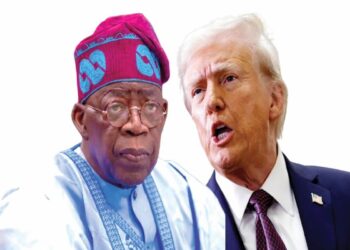
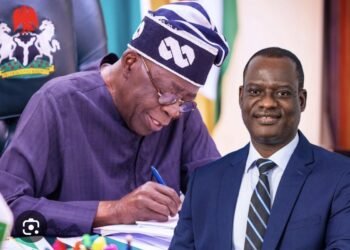
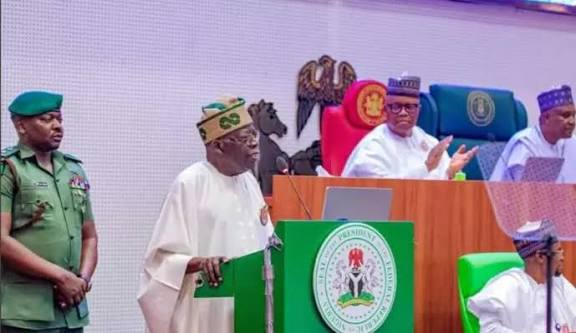
President Bola Tinubu on Friday presented the government’s N58.18 trillion spending plan aimed at consolidating economic reforms and boosting growth.
The deficit will come to roughly N23.85 trillion, he told lawmakers on Friday.
“The 2026 budget is anchored on realism, prudence and growth orientation,” Tinubu told lawmakers in Abuja. “We will spend with purpose, manage debt with discipline, and pursue growth that is broad-based, not narrow, and sustainable, not temporary.”
The proposed budget allocates N15.52 trillion to debt servicing and N26.08 trillion for capital projects, focusing on sectors such as security, infrastructure, education and health.
The budget is based on a projected crude oil price of $64.85 a barrel and includes a target oil output of 1.84 million barrels a day, with an exchange rate of N1,400 to the dollar.
Tinubu said inflation had plunged to an annual rate of 14.45% in November from 24.23% in March, while foreign reserves had surged to a seven-year high of $47 billion.
“These outcomes are not accidental. They reflect difficult but deliberate policy choices,” he said.
Tinubu did not give a growth target but his budget chief on December 3 projected 4.68% growth for 2026, just above the World Bank’s 4.4% forecast.
Tinubu, during the presentation, said, “I appear before this Joint Session of the National Assembly, in fulfilment of my constitutional duty, to present the 2026 Appropriation Bill.” Tinubu described the moment as “defining” in Nigeria’s reform journey. He acknowledged the pains of reforms over the last two and a half years but assured citizens that “their sacrifices are not in vain.”
The President said Nigeria’s economy was showing clear signs of stabilisation, citing 3.98 per cent GDP growth in Q3 2025, moderation in inflation for eight consecutive months to 14.45 per cent in November 2025, improved oil production, stronger non-oil revenues and rising investor confidence.
External reserves, he disclosed, climbed to a seven-year high of about $47 billion as of mid-November 2025, providing over 10 months of import cover.
Under the proposal, total revenue is projected at ₦34.33 trillion, while total expenditure stands at ₦58.18 trillion, including ₦15.52 trillion for debt servicing. Recurrent (non-debt) spending is put at ₦15.25 trillion, while capital expenditure totals ₦26.08 trillion. The budget deficit of ₦23.85 trillion represents 4.28 per cent of GDP.
“These numbers are not just accounting lines. They are a statement of national priorities,” Tinubu said, stressing commitments to fiscal sustainability, debt transparency and value-for-money spending.
Security tops sectoral allocations with ₦5.41 trillion, followed by infrastructure (₦3.56 trillion), education (₦3.52 trillion) and health (₦2.48 trillion).
Tinubu Designates Bandits, Militias, Armed Gangs, Others As Terrorists
Unveiling a sweeping security doctrine, Tinubu said Nigeria was resetting its national security architecture with a unified counter-terrorism approach. “Henceforth, any armed group or gun-wielding non-state actors operating outside state authority will be regarded as terrorists,” he declared.
He listed bandits, militias, armed gangs, kidnappers, violent cult groups, forest-based armed collectives and foreign-linked mercenaries, warning that financiers, ransom facilitators, arms suppliers, political protectors and even community or religious leaders who aid violence would also be designated terrorists.
President Admits Challenges Of 2025 Budget Implementation
On budget execution, Tinubu admitted that 2025 implementation faced transition challenges, noting that as of Q3 2025, ₦18.6 trillion in revenue (61% of target) and ₦24.66 trillion in expenditure (60% of target) had been recorded. Only ₦3.10 trillion, about 17.7 per cent of the 2025 capital budget, had been released by Q3.
He pledged stricter discipline in 2026, directing the finance and budget authorities to implement the budget “strictly in line with appropriated details and timelines.” Heads of Government-Owned Enterprises (GOEs) were ordered to meet revenue targets, backed by end-to-end digitisation to seal leakages.
“Nigeria can no longer afford inefficiencies or underperformance in strategic agencies. Every institution must play its part,” he warned.
Tinubu said investments in human capital would be deepened, revealing that over 418,000 students have benefitted from the Nigerian Education Loan Fund in partnership with 229 tertiary institutions. Health spending, he added, represents six per cent of the total budget, excluding liabilities, with over $500 million in prospective U.S. grant funding for targeted health interventions.
On food security, he said agriculture would be prioritised through mechanisation, irrigation, climate-resilient farming, storage and agro-value chains to curb post-harvest losses and boost smallholder incomes.
“The greatest budget is not the one we announce. It is the one we deliver,” Tinubu said, outlining commitments to better revenue mobilisation, smarter spending and stronger accountability.
Laying the bill before lawmakers, he said the 2026 budget benefited “belongs to all of us”, expressing confidence that cooperation between the executive and legislature would deliver the Renewed Hope Agenda.
“It is with great pleasure that I lay before this distinguished Joint Session of the National Assembly the 2026 Appropriation Bill of the Federal Republic of Nigeria,” Tinubu concluded. “May God bless the Federal Republic of Nigeria.”
Analysts List Challenges Of Implementation Of Budgets
Budget Implementation and Performance
Nigeria’s budget implementation has been facing challenges, with the 2023 and 2024 budgets extended into 2024, and the 2025 budget capital component starting in October.
READ ALSO:NMDPRA MD Farouk Ahmed Resigns Amid Corruption Allegations
Seen Onigbinde, co-founder of BudgIT, among other analysts, had expressed displeasure over vudget implimentations, particularly, under this administration.
According to Onigbinde, who featured recently on Channels Television, the development is an indicative of a lack of fiscal discipline and coordination among government agencies.
Performances:
Specifically, the 2025 budget was signed into law in February 2025, with a total expenditure of N54.99 trillion. However, the capital implementation has been slow, with concerns about the allocation of funds to constituency projects.
The National Assembly allegedly inserted 11,122 projects worth N6.93 trillion into the 2025 budget, which was approximately 12.61% of the total budget. This has raised concerns about transparency and accountability.
Also, the budget has been criticized for prioritizing recurrent expenditure over capital expenditure. This could impact the development of critical infrastructure and public services.
The allocation for recurrent expenditure is significant, with N13.64 trillion allocated for non-debt recurrent expenditure and N14.32 trillion for debt servicing ¹.
Promised January To December Cycle
Onigbinde expressed concerns about the government’s failure to adhere to a consistent budget calendar, which has created confusion around budget implementation and hindered effective national planning.
He noted that the current government has broken the covenant of having a budget cycle that runs from January to December.
Onigbinde, on Channels Television’s Politics Today program, stated:
“As of now, this is November 12, 2025 — we do not have the draft MTEF documents, we do not have the proposed budget, talk less of the 2026 budget… The 2023 and supplementary budgets were extended to 2024, and now we’re seeing the 2025 budget capital component just kicking off in October. That shows a gross disconnect and a challenge in the fiscal structure of the federal government.” He emphasized the need for the government to prioritize projects that align with national interests and for the President to show leadership in enforcing coordination.”