

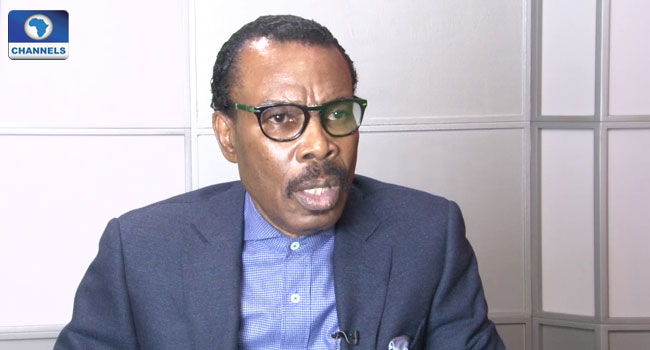
Chief Executive Officer of Financial Derivatives Company Limited (FDC), Mr. Bismarck Rewane, has projected that rising crude oil prices in the international market, from $64 per barrel (pb) to $110, would increase illegal revenue from illicit sale of crude oil by 136.80 per cent, from an estimated $3 million per day (pd) in January to $16 million pd April 2026.
Rewane stated this in his April 2026 presentation at the Lagos Business School Breakfast Session, captioned, “Inflation Surge, Externally Induced, Internally Magnified: Six-Dimensional Impact Analysis.”
Rewane said the surge in revenue from oil theft and bunkering would provide incentives for pipeline vandalism and cause oil militants in the Niger Delta not to be interested in security contracts for protecting oil infrastructures at $50 million per month.
He stated, “Higher oil price can worsen leakage and insecurity”.
Rewane added that “not all oil gains translate to national benefit”.
He estimated that 100,000bpd were diverted illicitly in January when oil price was $64pb and sold at discounted price of $30pb for $3 million revenue per day, which made providing security for government at $50 million per month a viable alternative.
But in April, with crude oil price as high as $110pb, Rewane projected that 200,000bpd would be stolen and sold at discounted price of $80pb for $16 million daily revenue, which would make the militants “no longer interested in security contracts”.
Speaking on “Oil Militants (Creek Economics),” Rewane said there will be “incentive for vandalism, oil theft and bunkering in the illicit market will increase” due to “increase profitability of illegal diversions.”
He also foresaw “increased pipeline vandalism, higher security costs to government and escalation in production losses.”
Using a particular brewery (name withheld) as a case study, Rewane said the profitability of Nigerian manufacturing sector would be compressed by 60 per cent.
According to him, this brewery recorded a revenue of N299.49 billion and recorded N25.41 billion profit in 2025, when it’s costs for raw materials, logistics, power and others were N149.02 billion, N3.76 billion, N11.82 billion and N109.42, respectively.
But following increase in price of diesel by between 80 and 100 per cent, costlier imports due to foreign exchange pressure and falling demand, Rewane projected that the new reality for thie brewery would be a revenue of N310 billion and a fall in profit to N10.80 billion.
He attributed the new reality to the rise in costs of raw materials, logistics, power and others to N165.70 billion, N5.4 billion, N17.3 billion and N110.8 billion, respectively.
He said rising input and energy costs will significantly compress profit margins, increase working capital pressure, and build inventory levels as sales slow.
Rewane stated, “Cost push inflation will erode industrial margins quickly.
“Even though Nigeria is among the beneficiaries of the oil price revenue, external shocks will continue to impact the economy as the country is increasingly integrated with global market.”
Rewane said the effect of military conflict in Iran that had disrupted global commerce through blockage of the Strait of Hormuz will trim Nigeria’s projected GDP growth of 3.8 per cent in the Q1’2026 to 3.2 per cent, squeeze private sector’s margins, trigger worker layoffs despite government revenue gains.
According to him, “Net employment will decline, consumption declines due to falling real incomes, investment remains flat showing limited sector response, exports increase while marginal propensity to import decreases.”
He further projected that the energy-induced shock would squeeze the middle class to financially fragility and push traders and SMEs to loss of profit.
According to him, the energy-induced shock of the ongoing United States of America/Israel war against Iran would be more impactful than all the previous Gulf wars combined.
Rewane said a salaried employee in Lagos with a wife and a child, who saved N150,000 monthly from his N1.2 million income in January would be in deficit of N110,000 by April.
He said, “A mid-level professional in Lagos, commutes daily, supports family, within 45 days, savings decline significantly as expenses outpaces income and discretionary spending reduces sharply.
“In 90 days, he would cut savings to zero, start borrowing/using credit, and cut food quality, visits to family and friends and discretionary spending
“Therefore, middle class gets financially squeezed into fragility as consumption drops, feeding directly into economic slowdown.”
According to him, a hypothetical trader, who is importing or buying goods wholesale and selling in local market would experience 50 per cent decline in profit between January and April 2026.
He attributed that to slowing inventory turnover, tightening cash flow, and significantly shrinking profit margins as costs rise faster than prices.
“Therefore, SMEs get hit from both sides of rising costs and falling demand. Leading to a rise in unemployment,” he said.
Using Kaduna State Government as a case study, Rewane projected that the state’s monthly FAAC would grow from N28 billion in January to N40 billion in April and reduce its deficit spending from N28 billion to N16 billion.
Rewane said Kaduna State’s “higher FAAC inflows reduce fiscal deficit and improve cash position” to enable the state to meet salary and debt obligations more comfortably, projecting that the state may spend productively by investing in infrastructure, pay contractors or increase recurrent and political spending and reintroduction of subsidies for the short term.
He also foresaw resurgence of inflation with headline inflation equalling15.85 per cent, food Inflation 14.94 per cent, and core Inflation 14.35 per cent.
He said, “Households would face a 15-20 per cent drop in real purchasing power as transport costs surge, inflating food and commodity prices by 15 to 30 per cent.
“Low-income families, spending 40 to 60 per cent of income on basics, would cut staples and healthcare, mimicking 2023 subsidy removal effects where inflation hit 34 per cent.
- “Rising fuel costs act like a multiplier, worsening both monetary poverty and non-monetary deprivations, and pushing more people into chronic multidimensional poverty.”