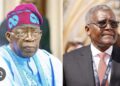


With about one year to the end of its first term, and three years after waiting for the promised uninterrupted power supply, the Bola Tinubu administration has constituted Grid Asset Management Company Limited (GAMCO) headed by his Chief of Staff, Femi Gbajabiamila, to tackle the incessant power outtages, ocassioned by collapses of the national grid.
Gbajabiamila, who also inaugurated the committee of all government officials, onbehalf of the President last week claimed that, in
proposing GAMCO, regarded as one of the revolutionary steps, Tinubu hopes to fast-track a quick-fix solution to the endemic problems of stranded power, grid management, and transmission in the country’s electricity sector, a statement by his media aide, Bayo Onanuga, disclosed
But Nigerians have exoressed concerns over the timing and composition of the committee which does not include tje private sector operatives.
Coming at a time when Nigerians have continued to experience darkness almost on daily basis and in the month that Aso Rock is slated to be disconnected completely from the national grid and switch to solar installation through allocation of ₦10 billion in 2025 budget plus a proposed ₦7 billion in 2026, for the “Solarisation of the Villa with Solar Mini grid, leaves much to be desired, Nigerians say.
Most Nigerians have come to terms that despite promises by the administrarion of a lease of life, the national grid has become something of an unreliable metaphor for the country itself, functional one moment and collapsed the next.
For instance, in 2024 alone, the grid reportedly collapsed more than 10 times. By mid-2025, Nigeria had already recorded multiple partial and total system failures, plunging Lagos, Abuja, Kano, Port Harcourt and other major cities into darkness.
Also, in 2025, the country experienced multiple failures, with the last incident on 29 Dec 2025 and other major drops in September, February and March 2025 (partial/total failures, with DisCos seeing zero MW.
This year, 2026, first total collapse was recorded on 23 January, with generation fallen to zero MW, and all the 11 DisCos losing load.
While calling for the decentralisation and unbundling of the single grid into regional networks and introducing DisCo competition, they are also questioning the relevance of the Siemens Presidential Power Initiative (PPI), revived under Tinubu administration to raise transmission from 5,000 MW to 7,000 MW (phase 1), 11,000 MW (phase 2) and 25,000 MW (phase 3).
Although framed as the “most comprehensive” fix, but progress has been slow.
Nigerians React To Inauguration Of GAMCO
He (president) should disconnect Villa from the solar and return to the national Grid. It’s then that I know he is serious about fixing electricity, says a concerned Nigerian, in a whatsapp message to MBN.
“Nigeria’s power sector crisis is fundamentally a transmission problem disguised as a generation problem. While installed generation capacity stands above 13,000 MW, transmission infrastructure managed by the Transmission Company of Nigeria (TCN) can barely wheel 5,500 MW under optimal conditions. Much of the grid infrastructure dates back to the 1970s and 1980s, operating with obsolete transformers, fragile substations and overloaded transmission lines.
Even in the first weeks of 2026, fluctuations in generation and transmission instability have forced load shedding across industrial clusters in Lagos, Ogun, Oyo and Kaduna states, with generation frequently falling below 4,000 megawatts (MW) for a country of over 200 million people.
READ ALSO:Oil Falls As Trump Predicts Middle East De-escalation
South Africa, often cited as Africa’s power sector example story, generates over 40,000 MW installed capacity, while Egypt exceeds 58,000 MW. Nigeria struggles to transmit 5,000 MW reliably on most days.
The reasons for this chronic dysfunction are neither mysterious nor new, but lack of political will to tackle the problems headon,” says an analyst.
“The minister of the sector, Mr. Adebayo Adelabu seems not prepared for the job as the situation has deteriorated rather than improvement. He should have been relieved of his position even before now. It’s unfortunate that we are in this mess,” says an energy analyst.
Another concerned Nigerian berated the government for politicising power issues, wondering, why the inauguration of the committee towards the end of the tenure, adding also that from the composition of the committee, it’s ‘bound to fail.’
The committee which is expected to examine the implications of the Electricity Reform Laws (2025) and related unbundling arrangements on asset ownership, management, and regulatory oversight, identify areas of conflict, overlap, or inconsistency between the proposed GAMCO framework and extant legal and regulatory framework, assess the legal status, ownership structure, and contractual obligations of the Niger Delta Power Holding Company (NDPHC) and National Integrated Power Project (NIPP) assets, among others, has, beside Gbajabiamila as the chairman, Attorney–General of the Federation and Minister of Justice, and the ministers of power, works, and finance as members.
Others include the ministers of communication and digital economy, science, technology and innovation, aviation and aerospace development, the minister of state (petroleum), the chairman of the Nigeria Revenue Service, and energy expert, Yemi Oke.
The Permanent Secretary of the Cabinet Affairs Office, John Ezeamama, is the committee’s secretary.