

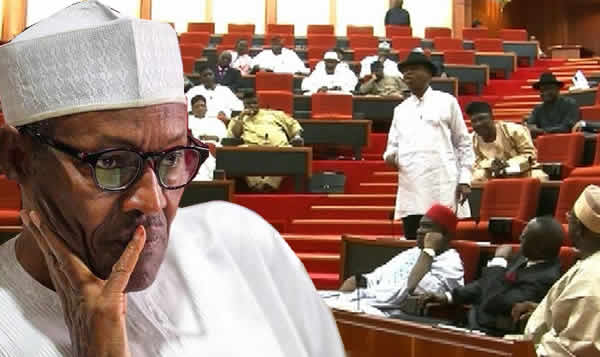
The recently passed 2018 Appropriation Bill has been transmitted to the presidency for the assent of President Muhammadu Buhari.
Sen. Ita Enang , the Senior Special Assistant to the President on National Assembly Matters (Senate), confirmed on Friday, the receipt of the 2018 Appropriation Bill.
The NASS had on May 16 passed the 2018 Appropriation Bill of N9.12 trillion.
The budget was increased by the legislature by N508 billion from the N8.61 trillion proposed and presented by President Buhari to the NASS in November 2017.
Enang, in a statement in Abuja, said he had received the 2018 budget passed by both chambers of the NASS and was set to be transmitted to the president for further action.
“I have received the 2018 Appropriation Bill for onward transmission to the President as soon as possible.
“Since the Appropriation Bill has been received, what is left is for it to be transmitted immediately to the President,” he said
The National Assembly on May 16, passed the 2018 Appropriation Bill of N9.12 trillion after it was increased by the lawmakers by N508 billion.
Chairman of the committee, Sen. Danjuma Goje, presented the budget and explained that it was premised on oil price benchmark of 51 dollars per barrel as against 45 dollars proposed by the president.
He added that it also benchmarked at crude oil production of 2.3 million barrels per day and exchange rate of N305 to one dollar.
Goje said that of the aggregate expenditure of N9.12 trillion, N530 billion was earmarked for Statutory Transfers while N2 trillion was earmarked for Debt Service.
He added that N3.5 trillion was earmarked for Recurrent Expenditure, N2.8 trillion for Capital Expenditure, N1.95 trillion for fiscal deposit, while Deficit to Gross Domestic Product was put at -1.73 per cent.
He recalled that the 2018 Budget as presented by Buhari had the objective of delivering on a three year (2018-2020) Economic Recovery and Growth Plan (ERGP).
“The Bill contained the estimates of revenue and expenditure totalling N8, 612, 236, 953, 214.
“It was made up of Statutory Transfers of N 456, 458, 654, 074 and Debt Service of N2, 233, 835, 365, 699.
“Recurrent (Non-Debt) Expenditure is N3, 494, 277, 820, 219 and Contribution to Development Fund for Capital Expenditure is N2, 427,665,113,222,’’ he said.
Goje disclosed that there was additional allocation to security to the tune of N47 billion, Reduction of Deficit, N51 billion and Health, N57 billion.
Other additional allocations, according to him, are Power, Works and Housing, N107 billion, N16 billion to Education, particularly for infrastructure for the 12 newly-established universities and meal subsidy in Unity Schools.
He also said that N10 billion was allocated to Judiciary while additional provision of N44 billion was allocated to Niger Delta Development Commission (NDDC).
The committee chairman, therefore, explained that the various additional allocations accounted for the budget increment from N8.61 trillion to N9.12 trillion.
He regretted the delay in the passage of the budget, but said that it was not entirely the fault of the National Assembly.
Lawmakers commented on the budget, with James Manager (Delta-PDP) saying that to avoid speculations, it was important to let Nigerians know that the increment in the budget was in consultation with the Executive.
Sen. Lanre Tejuoso (APC-Ogun) described the bill as a budget of transformation with the introduction of one per cent Consolidated Revenue Fund (CRF) in the health allocation.
He explained that the implication of the one per cent was that a minimum of 3,000 Nigerians in each local government area would have their health bills paid for by government.
In his remarks, President of the Senate, Dr Bukola Saraki, said that there was need to grow the economy away from oil.
He also said that government spending must continue to grow on issues relevant to the welfare and security of the people.
Saraki stressed that government spending should reduce in areas where the private sector was better placed to catalyse progress, adding that it would free up funds for education, health, water and sanitation services, among others.
“On this note, it is with great delight that I announce that the 2018 Budget has met the threshold of reserving at least one per cent of total budget to health.
“This is historic. We were focused on this commitment of the one per cent set aside for the Basic Health Care Provision Fund (BHCPF). We promised and we have delivered.
“For us, this is not a commitment to numbers; it is a commitment to the health and well-being of our people; it is a commitment to ‘making Nigeria stronger’.
“We expect that this will continue and even inch upwards as we work to eradicate malaria, and significantly reduce infant and maternal mortality.
“The statistics that show Nigeria as having one of the highest maternal mortality rates in the world is not the Nigeria we want to leave behind for our children.
“The journey starts now; let us not look back,” he said.
Saraki emphasised the need for the Executive and the Legislature to come together, especially in the formation and passage of Appropriation Bill.
He said that while progress had been made in the formation stages, a lot more needed to happen to minimise delays and other stumbling blocks in the process.
“One of the symptoms of the unhelpful aspects of the prevailing culture hampering the process remains the neglect or refusal of certain agencies of government to honour invitations to budget defence.
“It is our hope that we will see a major change in this regard, going forward.
“The Petroleum Industry Governance Bill (PIGB) has been passed; it should, of course, be duly signed and implemented so that our people can reap the full dividends of this landmark legislation.
“We would like to see that the process of implementation of the budget starts immediately so that our people will begin to benefit from the objective of the budget and opportunities it opens.
“In order for us to have an efficient budget implementation, we will advise that agencies of government eliminate unnecessary bureaucracy and speed up the procurement process,” he said.
Passing the Bill at the House of Representatives, the lawmakers warned the Federal Government not to engage in extra-budgetary spending unless through supplementary appropriation.
They also barred the government from borrowing without first furnishing the legislature with details of the borrowing plan and obtaining approval.
Chairman, House Committee on Media and Public Affairs, Rep. Abdulrazak Namdas, who briefed the media on the conditions given to the government, said that the House had constituted a conference committee to liaise with the Senate on the conditions.
He said that the budget must henceforth, run a full circle of 12 months.
“We have set up a conference committee to harmonise with the Senate based on the new clauses passed by the House.
“We believe that a clean copy of the budget will be ready by next week and sent to the president for assent.”
Namdas explained that the budget was jacked up based on a new oil benchmark of 51 dollars, crude oil production of 2.3 million barrels per day and an exchange rate of N305 to one dollar.
“After close consultation with the Executives, the increase in oil benchmark was applied in the following critical sectors of the economy – reduction of deficit amounted to N50.88 billion; security N46.72 billion; health N57.15 billion; power, works and housing N106.50 billion.” (NAN)