
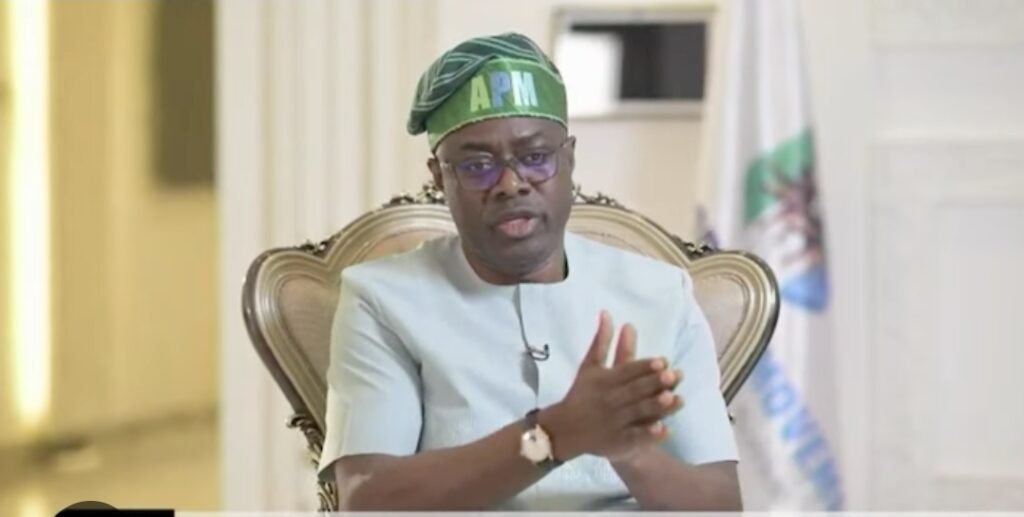
Oyo State Governor Seyi Makinde has accused the Bola Tinubu administration of using the Economic and Financial Crimes Commission (EFCC) to pressure governors into joining the ruling All Progressives Congress (APC), warning that Nigeria’s multiparty democracy is being threatened.
Makinde also confirmed that he is actively involved in discussions over a possible opposition alliance ahead of the presidential election, declaring his willingness to work with either Atiku Abubakar or Peter Obi if the arrangement offers the best path to defeating the ruling All Progressives Congress.
Makinde made the allegation and disclosure during an exclusive interview with ARISE News Anchor Ojy Okpe, as he criticised what he described as attempts to weaken opposition parties ahead of the presidential election.
Rather than seek to win over Nigerians who did not support the APC in the last presidential election, Makinde alleged that the ruling party had concentrated on attracting governors through coercion.
“What we’ve seen is, well, okay, I have the governors, they come to APC. If you don’t, you will be blackmailed,” Makinde said.
He illustrated his allegation by describing a scenario in which a contractor working for an opposition-controlled state could be subjected to scrutiny over contracts and financial transactions.
“The EFCC will come down from that place. ‘Look, how much did they award this to you? Go and bring your account. Who have you been paying?’ That is the situation that we are facing today,” he said.
Makinde did not provide evidence during the interview establishing that the EFCC had been directed by Tinubu or the APC to carry out such investigations.
The governor linked his allegation to what he described as a wider pattern of pressure on opposition parties and politicians, questioning why several opposition platforms were experiencing internal crises as the election approached.
He warned against Nigeria drifting towards a one-party political system, arguing that electoral contests should be decided by voters rather than through the courts, intimidation or pressure on political opponents.
Makinde nevertheless said he would accept defeat if Nigerians rejected his presidential bid in a properly conducted election.
“If the process is free, fair and credible, yes, I will,” he said when Okpe asked directly whether he would concede if he lost.
The governor, however, immediately expressed confidence that he would prevail at the polls.
Asked earlier about the possibility of losing, Makinde said: “I won’t.”
The EFCC has previously rejected claims that its investigations are politically motivated, maintaining that its mandate applies to public officials irrespective of political affiliation.
Makinde said the credibility of the election and the conduct of state institutions would ultimately be critical to whether its outcome commanded acceptance.
Asked directly whether he was open to an alliance with other leading opposition figures, the governor went further.
“Not only that I’m open, we’re actively discussing this,” he said.
Makinde declined to say whether he would prefer an arrangement with former Vice President Atiku or Obi, arguing that such a consequential political decision should be determined by evidence rather than personal preference.
“To arrive at a decision, you need data,” he said.
“We just won’t say, ‘Oh, okay,’ take emotional decision and say, ‘Oh, it’s you.’ We have manifestos , we have certain things in that manifesto. We will sit down, we have maybe historical performance. We also have the sentiment of the people. All of those things will come together and arrive at a decision.”
Makinde used his background in the oil and gas industry to explain how political rivals could become partners when their interests and capabilities aligned.
He said companies operating within the same field could compete in one circumstance, collaborate in another, or enter a commercial relationship depending on what was required to successfully develop an asset.
Applying the analogy to the presidential contest, Makinde said: “Depending on what we see between now and the election time, we may be rivals, we may be collaborators, we may be — one may be the client of the other.”
Asked whether he was prepared for such an arrangement in pursuit of his campaign to “reset Nigeria,” Makinde replied: “To reset Nigeria, yes.”
Okpe then asked specifically whether Makinde would work with Atiku if available data showed the former vice president was the strongest candidate around whom the opposition should coalesce.
“Yes,” Makinde replied.
“I’m willing to work with any Nigerian.”
The governor also invoked the 1999 presidential election, noting that Olu Falae performed overwhelmingly well in the South-West but could not translate regional strength into a national victory.
“Our biggest challenge is, first, to agree on what is the best course of action, and then seek an alliance,” Makinde said.
He also pointed to South Africa’s experience of political cooperation as evidence that competing political forces could negotiate an arrangement when circumstances demanded it.
“That negotiation will not be anything personal,” Makinde said. “That negotiation will be the deal for Nigeria, by Nigeria.”
Makinde has repeatedly framed the coming presidential contest as a battle between the APC and Nigerians dissatisfied with the direction of the country, while insisting that personal presidential ambitions should not prevent opposition figures from finding a common electoral strategy.