
*30-Day Fuel Discount Exposes Cracks in Fiscal-Monetary Coordination
John Danjuma Omachonu
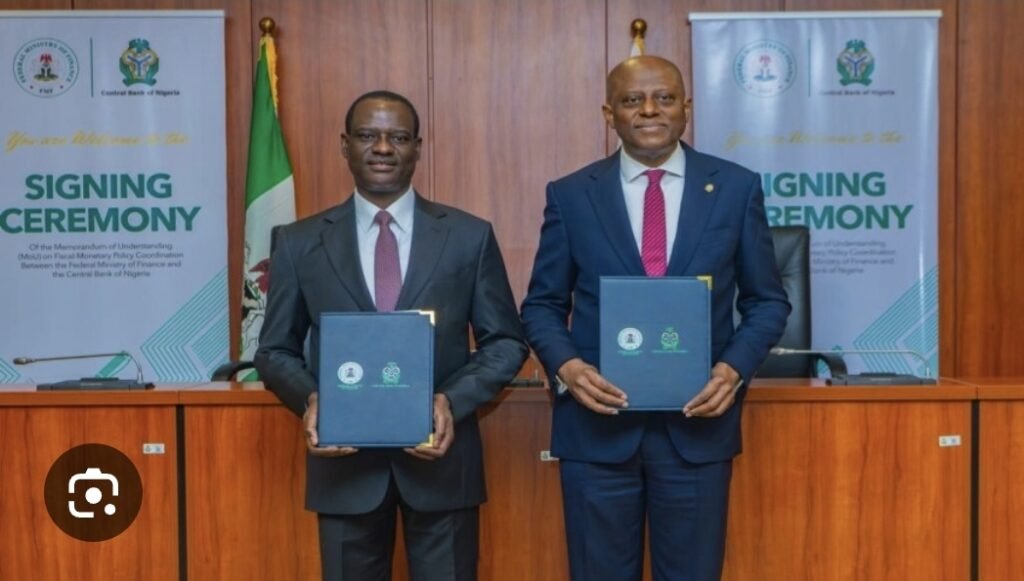
Nigeria formally institutionalised policy coherence on September 18, 2026, when the Finance Ministry and the Central Bank, (CBN) signed a Memorandum of Understanding on Fiscal-Monetary Coordination.
CBN Governor, Olayemi Cardoso, at the ocassion called it “a structured framework for regular consultation.”
Taiwo Oyedele said: “Strong economies are not built around strong personalities. They are built around strong institutions.”
The MoU had six pillars and promised to align macroeconomic assumptions, for both institutions to align forecasts for inflation, GDP, revenue, liquidity, external sector as well as stronger structured information-sharing, with a clear mechanisms to avoid working at cross-purposes.
The pillars also include, coordinated approach to inflation: with disciplined fiscal spending, including measures to reduce food, energy, logistics costs as well as strategic grain reserves, rural roads, tackling illegal levies.
Pillar four talks about the need for a continued fuel price stability without reintroducing consumption subsidies. The document explicitly said: maintain stability in fuel prices without reintroducing distortionary subsidies. Tax exemptions and exchange-rate stability to moderate pump price.
The last two talk about expanded and more frequent economic data, including New Producer Price Index, (PPI), employment, productivity data with NBS to support inflation targeting and, closer coordination of financing and cash management: This is to reduce government borrowing crowding out private credit. It also included strengthening Fiscal Responsibility Commission, BPP, NEITI.
However, twenty days later, pillar four collapsed. On October 8, Oyedele announced the opposite of pillar 4, a 30-day discount on NNPC petrol, priority for transporters, and a negotiated N1,350 per litre ceiling on landing cost where refiners/importers absorb shortfall and recover later.
He said: “It’s not a subsidy, government is just saying we sell to you at cost.”
But the analysts say fuel price stability without subsidy may have failed the first test, ocassioned by confusion and contradictions being experienced in the various cities.
This is even as market prices of N1,320-N1,380 are existing in Lagos/Abuja; N1,400-N1,500 North as Brent crossed $100 after Iran-US Strait of Hormuz disruption.
Consequently, the N1,350 ceiling is already below MEMAN import cost N1,364-N1,365 and at Dangote gantry N1,350.
According to the analysts, if refiners absorb the differentials, who pays? This amounts to quasi-fiscal subsidy not in budget, and that’s exactly what MoU said it would avoid.
Also, CBN had, on September 22 embarked on a biggest cut since 2006, reducing the Monetary Policy Rate (MPR) from 26.5% to 23% on the basis that inflation was moderating, with headline trading at 15.39% in August from 15.43% in July, food 19.57% from 20.31%, core 13.29% from 14.97% and reserves $55.25bn, 18-year high, 11.3 months cover and Naira official rate at N1,330/$
The implication, according to some analysts is that the tightening-fighting-dis-inflation narrative is now contradicted by fiscal easing on fuel, at variance with what the MoU was meant to stop.
Similarly, the Pillar 3, on inflation is not faring better either, as they claim that food inflation at 19.57% is still punitive.
“Even at that, lower inflation should not be confused with lower prices. When inflation falls from 30% to 15%, the damage remains. Purchasing power destroyed is not restored,” says an analyst
Metrobusinessnews.com survey show that a bag of rice at N85,000 in Mile 12, from N42,000 pre-subsidy removal.
The first two pillars aligned assumptions and info sharing as CBN projects disinflation to single digits, reserves stability, naira N1,330.
Finance Ministry projects fiscal relief via discount that lowers FAAC remittance and increases import demand for FX, amounting to ‘one tightens, one loosens, hence market confusion.
Pillar six deals with coordination of financing. However, our checks reveal that despite high CBN liquidity at N7.45tn and MPR at 23 percent, banks charge 32-45% for commerce as they continue to raise.concerns over CRR still at 45 percent.
Indeed, government borrowing continues to crowd out the private sector. For instance, the federal government borrowed N2.1trn in Q3 via bonds at 19%.
Also, discount window adds contingent liability not captured in debt issuance plan MoU promised to coordinate.
Pillar five that deals with data is also not better as old CPI is still being used, even as there is PPI. The employment data was last released Q2 2024.
The Place Of Consumers
The analysts were unanimous in their submissions that the development has eroded the purchasing power of Nigerians.
For instance, the current minimum wage of N70,000 buys 50 litres of petrol at N1,400 — 1.5 tankfuls. But in May 2023 at N195/litre, same wage of N30,000 bought 153 litres, an indication of real wage collapse, they argue.
On interest rates, although the CBN reduced it to 23 percent, commercial lending ranges between 28-45%, a development that has removed the SMEs from borrowing to produce.
The widening gap between the official exchange rate at N1,332.90/ $, Parallel, at N1,357/$ us slso concerning. According to the analysts, although the gap is narrowing to N24 or 2-3%, which is a good story for CBN, it is still a breach of the MoU FX stability promise.
Market observers say although the MoU was historic, the institutions do not change behaviour with signatures as the authorities may be under political pressure from labour, elections, and cost-of-living.
Also, CBN is said to be under intense pressure to defend naira and single-digit inflation target.
“When petrol hit N1,400, political logic overrode institutional logic. Discount window is political, not economic. It contradicts pillar 4, confuses pillar 1-2, and makes pillars 3 and 6 impossible. MoU is paper, politics is reality,” Lagos based analyst said.
Commenting on the development, which he regards as worrisome, financial analyst said, “CBN is mopping up liquidity with high rates, Finance Ministry is injecting pain via high energy costs. Both claim to fight inflation, but both create cost-push inflation. This is classic policy contradiction.”
“The Sept 18 Fiscal-Monetary MoU is being celebrated as a ‘Wedding of Two Elephants’, but elephants dancing trampling and suffocating the grass, he said.
Consequently, the analysts expect CBN to maintain tighter monetary policy stance for longer to offset fiscal easing, even as the MPR cut to 21 percent could possibly happen early 2027, depending again, on the political environment.