
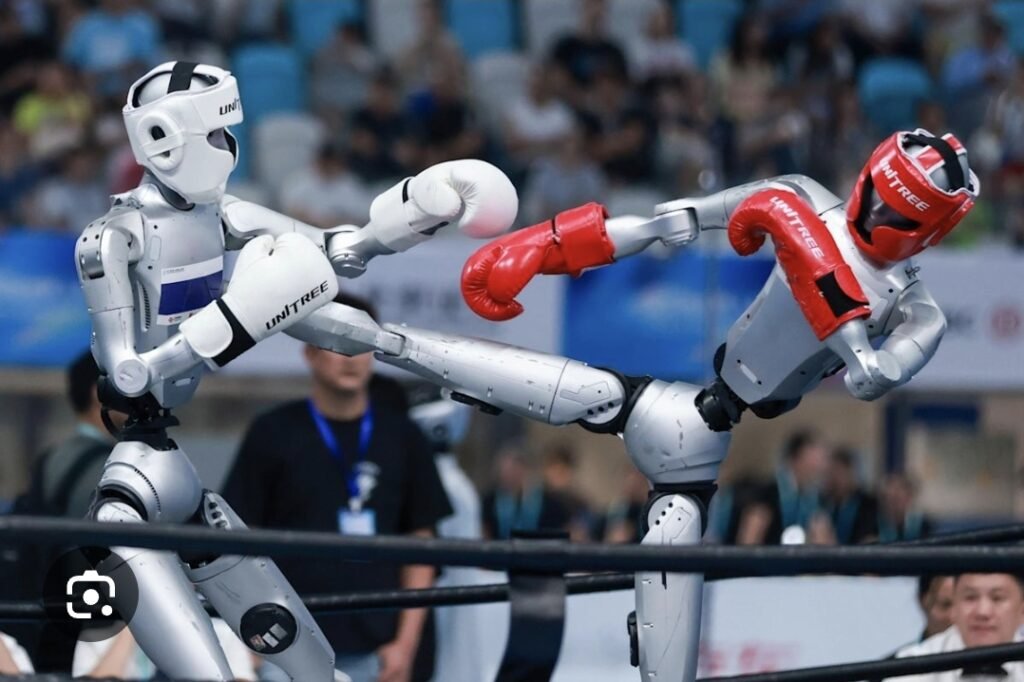
At the World Humanoid Robot Games in China last month, robots jumped, boxed, danced and raced, showcasing rapidly advancing capabilities while entertaining spectators with occasional stumbles.
Two days after the competition ended, the People’s Liberation Army’s official newspaper drew a different conclusion from the technological display, urging researchers to speed up the transfer of cutting-edge innovations from laboratories to military training grounds for robotic “combatants.”
China’s defence establishment is accelerating research into military applications for humanoid robots and preparing for their potential deployment in future conflicts, according to a Reuters review of more than 100 Chinese military procurement notices, academic studies, patents, government records, official publications and defence-company materials.
The previously unreported records indicate that Chinese military institutions are testing humanoid robots against battlefield requirements, seeking robots and related technologies for training and studying how the machines could operate alongside soldiers.
READ ALSO:NERC Orders DisCos To Channel 60 Percent Operational Revenue Into CapEx
The research gained momentum in 2025 and 2026, with a focus on areas including robotic perception, manipulation and training data.
Chinese manufacturers accounted for about 95 per cent of global humanoid robot shipments in 2025, according to BofA Global Research. The country’s dominance of the commercial market gives the People’s Liberation Army access to a rapidly expanding domestic robotics industry as it develops military applications.
China’s research reflects a broader global push towards autonomous military systems as armed forces seek technologies capable of performing dangerous or demanding tasks.
The Russia-Ukraine war has accelerated that interest, with semi-autonomous drones using artificial intelligence for navigation and targeting transforming reconnaissance and attacks, while ground robots have been deployed to transport supplies and evacuate casualties.
Reuters has previously documented efforts by the Chinese military to study technological lessons emerging from the war, which has become Europe’s deadliest conflict since World War II.
Dennis Hong, a professor of mechanical and aerospace engineering at the University of California, Los Angeles, said the ability to send robots into dangerous environments is among the strongest arguments for developing them.
“Going where we don’t want humans to go is one of the most compelling reasons to develop robots in the first place,” Hong said. “If losing a robot means avoiding the loss of a human life, then the robot can become expendable.”
China’s defence ministry and the National University of Defense Technology, the People’s Liberation Army’s leading research institution, did not respond to requests for comment on the military applications of humanoid robots.