
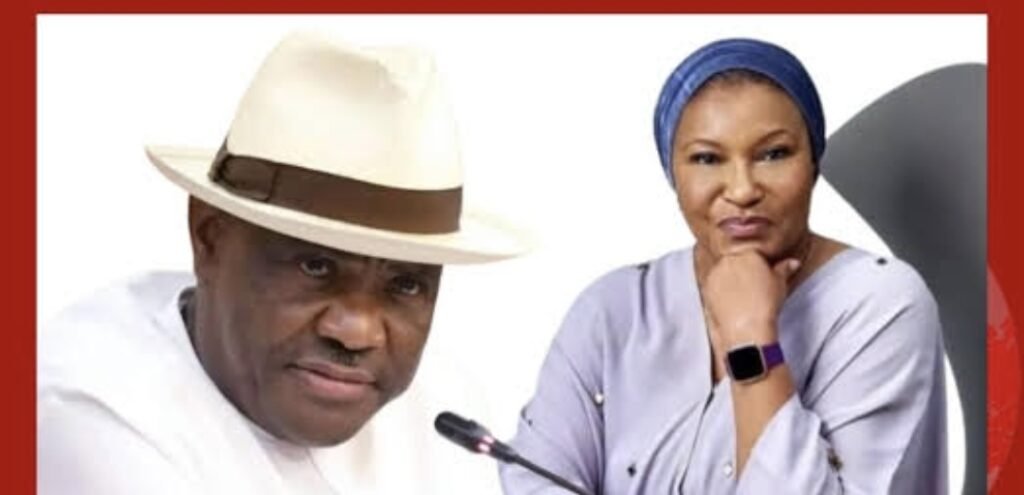
The senator representing the Federal Capital Territory (FCT), Ireti Kingibe, has alleged that the Minister of the FCT, Nyesom Wike, has taken loans without the National Assembly’s approval.
Kingibe made the allegation during an interview on Channels Television on Tuesday, while speaking on the FCT administration, the Abuja master plan and the oversight responsibilities of the National Assembly.
According to Kingibe, the Debt Management Office (DMO) records indicated that loans had been taken for the FCT between August 2023 and March 2026, despite Wike not appearing before the Senate to seek approval for such borrowing.
Kingibe noted that she had brought the issue of Wike’s borrowing to the attention of the Senate leadership.
She said, “I am definitely saying Wike has been taking loans without the approval of the National Assembly.
“I’m sorry to say, with all due respect to the Senate, of which I’m a member, we’re supposed to oversee him.
“We’re supposed to approve, and I have brought to the attention of the leadership of the Senate that the FCT is borrowing money.
“I have never seen Wike come to the National Assembly, come before the Senate, to ask for approval for anything. He comes before the FCT Committee, and that’s the only time it ever sat.”
Also, former Ministee of Sports Solomon Dalung, recently raised the alarm on the alarming rising debt profile of FCT, calling on Nigerians to demand for explanations from Wike.
“Do you know how much debt the FCT has accumulated under the man who wants to “Win Election at All Cost”?
Read along with me, because this is no longer just about Wike. It is about public money, public debt and the quality of accountability we are prepared to accept from those who govern us.
When Nyesom Wike became FCT Minister in August 2023, Abuja’s domestic debt stood at N88.51 billion.
By March 2026, it had risen to N389.88 billion.
That is an increase of N301.37 billion, representing a 340.5 percent jump. Abuja moved from being the ninth-lowest indebted sub-national government in Nigeria to the second-highest. These figures are from the Debt Management Office and were analysed by Premium Times. (Premium Times Nigeria)
But the most revealing part is not even the final figure. It is the speed at which the debt accumulated.
The debt was N71.04 billion in June 2025.
N78.93 billion in September.
Then suddenly, N188.86 billion in December.
By March 2026, it was N389.88 billion.
So, in roughly seven months, the FCT added more than N300 billion to its domestic debt. Between December 2025 and March 2026 alone, the debt increased by N200.99 billion. (Premium Times Nigeria)
Now, here is where the story gets even more interesting.
This happened under an administration that was not merely spending existing revenue. It was also operating with considerably greater control over the FCT’s finances.
In October 2023, shortly after Wike assumed office, the FCT Administration was removed from the Treasury Single Account. Wike said the decision was necessary because the FCT was not a revenue-collecting agency of the Federal Government. (Premium Times Nigeria)
In practical terms, the FCT gained greater financial autonomy over its internally generated revenue.
And the revenue itself was growing.
Wike has repeatedly pointed to a dramatic increase in the FCT’s internally generated revenue, saying monthly IGR rose from about N9 billion when he assumed office to more than N40 billion. (Leadership)
The FCT-IRS also reported record IGR collections in the period. Its own website confirms that the agency is the statutory revenue authority responsible for taxation in the territory. (FCT Internal Revenue Service)
Then consider the federally distributed revenue.
According to Premium Times’ analysis of FAAC records, the FCT received N432.13 billion between August 2023 and March 2026 alone. That figure does not even include internally generated revenue and other receipts. (Premium Times Nigeria)
So let us put the picture together.
Revenue increased.
The FCT gained greater control over its internally generated revenue.
The territory received more than N432 billion in FAAC allocations during the period.
READ ALSO:Oil prices Fall $2 On Iran-Oman Talks To Reopen Strait of Hormuz
And yet, within the same period, domestic debt moved from N88.51 billion to N389.88 billion.
This is where Nigerians must stop arguing about whether Wike is a good politician or a bad politician.
Ask the financial question.
Where did the money go?
What exactly was financed with the additional N301.37 billion in domestic debt?
Which projects were funded from internally generated revenue?
Which were funded from FAAC receipts?
Which were financed through borrowing?
How much was borrowed under each facility? From whom? At what interest rate? For what tenure?
And what is the total repayment obligation?
These are not hostile questions.
They are the most basic questions any serious government should be prepared to answer.
Nobody is saying borrowing is inherently wrong. A government can borrow responsibly to build infrastructure that expands economic activity and creates value.
But debt must be judged against three things: the purpose of the borrowing, the cost of the borrowing and the government’s capacity to repay it.
And in the case of Abuja, there is another issue that cannot be ignored: transparency.
Premium Times reports that it could not find successive FCT budget documents, budget performance reports and audited financial statements covering the Wike period on the FCT Administration’s website. The newspaper says that this makes it difficult to independently establish the precise purposes of the additional borrowing, the terms of the loans and how the funds were deployed. (Premium Times Nigeria)
That is a serious problem.
Because you cannot ask citizens to celebrate infrastructure while denying them the financial information required to understand what those projects actually cost..”
Writing further, Dalung said “The FCT belongs to the Nigerian people.
Its revenues belong to the Nigerian people.
Its assets belong to the Nigerian people.
And its debts are ultimately liabilities of the Nigerian people.
That is why this conversation must go beyond Wike.
The bigger question is whether we are becoming a country where governments are judged by the visibility of what they build, while nobody is allowed to ask sufficiently hard questions about what those things cost and who will pay for them.
I am not asking Nigerians to condemn Wike.
I am asking Nigerians to demand the books.
Because N88.51 billion becoming N389.88 billion is not a political slogan.
It is a financial fact.
And N301.37 billion is too much public money to be explained away with politics.”