
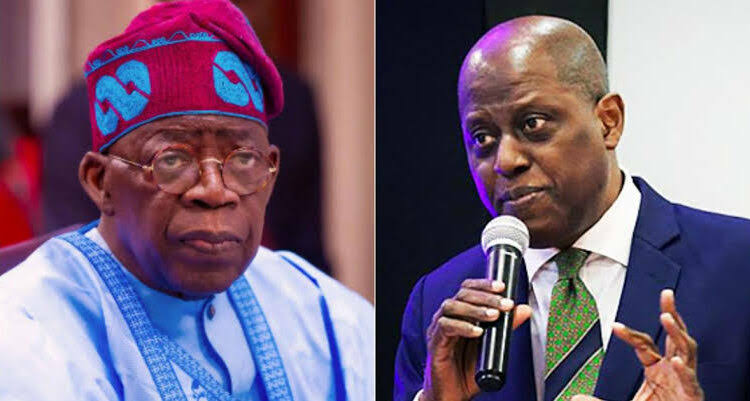
Most Nigerians have expressed serious concerns over plans by the Bola Tinubu government to secure $5 billion borrowing arrangement from the First Abu Dhabi Bank of the United Arab Emirate.
While some have raised alarm over the burgeoning debt overhang amid claims of increased revenue by the government, other have continued to blame the National Assembly, particularly the Senate for what they regard as lack of due diligence.
Responding to the published story on metrobusinessnews.com platform, an analyst responded:
“My brother, when you look at some of the clauses in the deal, like outrageous collateralisation, Nigeria bearing the losses ocassioned by the devaluation of the local currency, naira, as well as UAE taking all the possible accrued gains, and many other unreasonable clauses, you will ask yourself whether the country has National Assembly that is alive to its responsibility of scrutiny and oversight functions. The deal amounts to surrendering all our economic rights as a sovereign country. It’s a shame that Nigeria has found itself in this situation.”
Some other Nigerians have stormed social media pages of UAE Bank to express outrage and opposition over the planned borrowing deal, under the Total Return Swap, financing structure.
Specifically, the development is coming after the International Monetary Fund on Tuesday cautioned the administration of Tinubu against proceeding with the proposed $5 billion borrowing arrangement.
The warning was issued by the IMF Resident Representative for Nigeria, Christian Ebeke, during the presentation of the Fund’s 2026 Article IV Consultation Report on Nigeria.According to the IMF, the proposed financing arrangement is opaque and could expose Nigeria to significant financial risks.
Ebeke explained that such structures often lack transparency and may leave participating countries vulnerable to losses if the value of underlying assets declines or exchange rates move unfavorably.
Angered by Nigeria’s rising debt profile and worsening economic hardship, many Nigerians flooded comment sections on social media platforms, warning the Bank against approving theloan for the Nigerian government.
READ ALSO:NGX Group Advances ESG Agenda Through World Environment Day Cleanup Exercise
But, analysts say, it is a matter of regret that it took an international institution to expose some hidden tendencies toward corruption even after the papers have been scrutinised by both the executive and the legislature.
They further argue that the development may have rubbished the claimed fight against corruption by the government.
On Tuesday, June 9, 2026, President Tinubu, at the commissioning of the new office complex of the Economic and Financial Crimes Commission, EFCC, in Ado-Ekiti, described the project as a critical investment in the consolidation of Nigeria’s anti-corruption reforms and the Renewed Hope Agenda of the Federal Government.
President Tinubu, represented by Vice President Kashim Shettima, commended the Executive Chairman of the EFCC, Mr. Ola Olukoyede and the entire management and staff of the Commission for their commitment to institutionalizing the fight against corruption and strengthening the Commission’s operational capacity.
According to the President, the completion of the state-of-the-art facility demonstrates the Commission’s determination to make a lasting impact in the lives of Nigerians and enhance the effectiveness of anti-corruption efforts across the country.
He stressed that providing modern infrastructure and improved welfare for personnel of law enforcement agencies remains a strategic national imperative, noting that the EFCC occupies a central position in Nigeria’s economic reform and national security architecture.
Tinubu highlighted some of the Commission’s recent achievements, including its role in dismantling a foreign-controlled cryptocurrency investment fraud syndicate in Lagos in 2024, leading to the conviction of 192 foreigners, as well as its efforts in tackling Ponzi schemes and supporting Nigeria’s successful exit from the Financial Action Task Force (FATF) Grey List.
He also lauded the EFCC’s aggressive asset recovery drive, noting that recovered proceeds have supported critical social intervention programmes such as the Students Loan Scheme and Consumer Credit Scheme.
The President further praised the Commission’s successful prosecution of high-profile corruption cases, including the convictions of a former minister and a former managing director of a national investment bank, saying such outcomes send a strong message that corruption will not be tolerated in Nigeria.
Reaffirming his administration’s commitment to strengthening anti-corruption institutions, the President pledged continued government support through improved working conditions, enhanced welfare packages, adequate training opportunities and operational independence.
“My administration will continue to invest in strengthening the anti- corruption agencies through incentives, such as good and conducive working environments, competitive welfare packages, unfettered freedom to operate, adequate training opportunities, among others. Your daily sacrifices in staking your comfort and safety for our wellbeing will not be taken for granted,” he said.