
A new U.S.-military-led task force specializing in intelligence collection on drug cartels played a role in the Mexican military raid on Sunday that killed the Mexican drug lord known as ‘El Mencho,’ a U.S. defense official told Reuters.
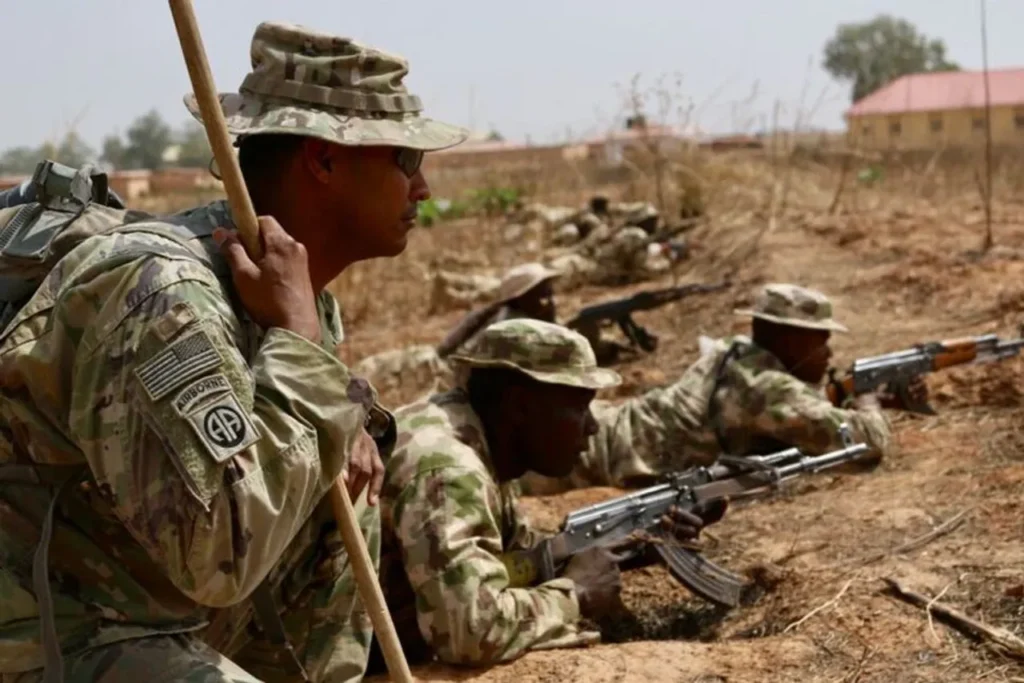
However, while Donald Trump’s administration is fighting hard to dismantle the drug cartels and lords in Mexico, about 100 US soldiers are currently in Nigeria to train the West African nation’s armed forces and help them with intelligence in their battle against growing security threats from Islamist militants and other armed groups.
Nigeria’s security forces face an array of existential threat and security challenges from Islamist militants, criminal kidnapping gangs as well as clashes over land and separatist unrest
The troops and equipment had landed at an airfield in the north-eastern state of Bauchi, defence spokesperson Maj Gen Samaila Umilitid last week
He reiterated that the US personnel would not be engaging in combat operations and had come at the request of the government.
This is the latest sign of military co-operation between the two countries following the Christmas Day airstrikes launched by the US on two camps run by an Islamist militant group in north-western Nigeria.
The government said it had asked for help in tackling Islamist militant groups such as Boko Haram, Islamic State in West Africa Province (Iswap) as well as other groups.
“The collaboration will provide access to specialised technical capabilities aimed at strengthening Nigeria’s ability to deter terrorist threats and enhance the protection of vulnerable communities across the country,” Maj Gen Samaila Uba said in a statement.
The deployment came after discussions between Nigerian and US defence officials during a working group, he explained.
It also follows confirmation earlier this month by the US Africa Command that a small team of American forces was already operating in the country. Nigerian military officials had previously indicated that around 200 additional troops were expected.
Late last year, the administration of US President Donald Trump raised concerns about the treatment of Christians in Nigeria – and urged the government to do more to improve security and strengthen protection for Christian communities.
Trump had previously claimed there was a “Christian genocide” under way in Nigeria – an allegation strongly rejected by Nigeria’s government, which said Muslims, Christians and people of no faith were victims of attacks.
However, in Mexico, the Joint Interagency Task Force-Counter Cartel, which involves multiple U.S. government agencies, was formally launched last month with the goal of mapping out networks of drug cartel members on both sides of the U.S.-Mexico border, U.S. officials said.
The U.S. official, who spoke to Reuters on condition of anonymity, did not offer further details on any information that the U.S.-military-led task force may have offered Mexican authorities.
The official stressed the raid itself was a Mexican military operation.
A former U.S. official, speaking on condition of anonymity without referring specifically to the task force, said the U.S. compiled a detailed target package for El Mencho and provided it to the Mexican government for its operation.
This detailed dossier included information provided by U.S. law enforcement, U.S. intelligence, the former official said.
The former official added El Mencho was very high, if not at the top, of a list of U.S. targets in Mexico.
READ ALSO:Trump Curious On Iran’s Resilience As Two Longtime Adversaries Meet Thursday For Talks
Mexican authorities killed drug lord Nemesio Oseguera, commonly known as ‘El Mencho,’ during an operation designed to capture him in the western state of Jalisco.
The operation set off a wave of violence, with torched cars and gunmen blocking highways in more than half a dozen states.
Mexico’s defense ministry said U.S. authorities had provided “complementary information,” but offered no details. A Mexican government source familiar with the operation said the Mexican government designed and executed it, and that no U.S. military personnel were physically involved.
An ex-police officer, Oseguera, 60, was the shadowy leader of the powerful Jalisco New Generation Cartel (CJNG), an international criminal enterprise widely viewed as one of Mexico’s most powerful.
He managed to evade arrest for years despite a $15 million bounty from the U.S. for information leading to his arrest or capture.
The kingpin’s killing notches a major victory for Mexico’s war on drug cartels that are responsible for smuggling billions of dollars in cocaine and fentanyl into the U.S.
President Donald Trump’s administration has waged a pressure campaign on Mexican President Claudia Sheinbaum’s government to ramp up its crackdown on drug trafficking, including U.S. threats to intervene directly in Mexico.
U.S. MAPPING OUT CARTELS
There is little information publicly available about the U.S. Joint Interagency Task Force-Counter Cartel, or JITF-CC.
Its website says its goal is to “identify, disrupt, and dismantle cartel operations posing a threat to the United States along the U.S.-Mexico border.”
U.S. Brigadier General Maurizio Calabrese, who leads the task force, spoke to Reuters this month about how the U.S. military is channeling its experience battling groups like al Qaeda and Islamic State to map out cartel networks.
“The cartels operate differently than al Qaeda or ISIS, different motivations, which make it even more important for us to identify entire networks so that we can disrupt and dismantle (them),” Calabrese told Reuters, using an acronym for Islamic State.
Calabrese noted that estimates vary widely but said there were possibly a few hundred core cartel members “at the top.”
“But then you have anywhere from 200,000 to 250,000 independent contractors that will help you move these drugs,” Calabrese said.
Jack Riley, a former senior official at the Drug Enforcement Administration, said Trump’s designation of Mexican cartels as terrorist organizations last year unlocked new kinds of U.S. military assistance.
He said that could be helpful when it comes to U.S. military intelligence, surveillance and reconnaissance resources.
“Our surveillance capabilities are going to be probably unlimited, and that will really help with real-time stuff,” Riley told Reuters.
“But these guys are extremely astute at being able to cover their tracks, cover who’s in charge and where those people are.”
A second U.S. defense official, speaking to Reuters ahead of the Mexican operation, said the new task force fit into a broader U.S. strategy to combat drug trafficking that has seen the U.S. military take increasing operational control of the border with Mexico.
It also includes now-regular U.S. strikes on suspected drug boats in Caribbean and Pacific waters, the legality of which has been challenged by Democratic lawmakers and legal experts.
“The whole idea of creating an interagency effort is to not have stray voltage, is to bring it all together, synchronize it,” the second official said of the task force.