
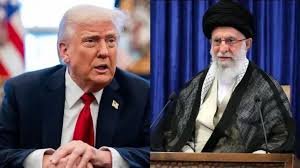
Iran’s supreme leader Ayatollah Ali Khamenei has vowed not to yield after U.S. President Donald Trump threatened to come to the aid of protesters.
This is even as rights groups reported a sharp rise in arrests following days of unrest sparked by soaring inflation.
Speaking in a recorded appearance on Saturday, Khamenei said the Islamic Republic “will not yield to the enemy” and that rioters should be “put in their place”, reports Reuters.
But, President Trump has promised to run Venezuela on temporary basis following the attack and arrest of its president, Nicolas Maduro, a striking departure for a politician who long criticized others for overreaching on foreign affairs and vowed to avoid foreign entanglements.
His vision for U.S. involvement in Venezuela, sketched out in a midday news conference, left open the possibility of more military action, ongoing involvement in that nation’s politics and oil industry and “boots on the ground.”
The term suggests military deployment of the sort that presidents often avoid for fear of provoking domestic political backlash.
“We are going to run the country until such time as we can do a safe, proper, and judicious transition,” Trump said.
He gave little sense of how far he was willing to go to gain control of Venezuela, where Maduro’s top aides appeared to be still in power.
Maduro and his wife Cilia Flores have been charged at Manhattan federal court, at Stewart Air National Guard Base in Newburgh, New York.
As recently as his inauguration for a second term last January, Trump told supporters: “We will measure our success not only by the battles we win, but also by the wars that we end, and perhaps most importantly, by the wars we never get into.”
But, on Saturday, U.S. forces attacked Venezuela and seized Maduro, who has been widely condemned as an illegitimate leader, and his wife Cilia Flores.
Trump had been urging Maduro to cede power and has accused him of supporting drug cartels that Washington designated as terror groups, alleging they were responsible for thousands of U.S. deaths tied to illegal drug use.
Since September, U.S. forces had killed more than 100 people in at least 30 strikes on alleged drug trafficking boats from Venezuela in the Caribbean and Pacific, which legal experts said likely violated U.S. and international law.
But the crisis in Iran is escalating on daily basis with deaths recorded in some instances.
Infact, state-affiliated media reported three deaths on Saturday, with rights groups saying more than 10 had already died in demonstrations across Iran since Sunday as the collapsing rial currency hits an economy already undermined by sanctions.
ECONOMIC CRISIS
Videos circulating on social media, which Reuters could not immediately verify, purported to show protests in southern and western Iran. In one, marchers called on other Iranians to come onto the streets, chanting “We don’t want spectators: join us”.
Mehr and Fars news agencies, both state affiliated, reported that a security forces member and two demonstrators were killed in Malekshahi, a western town, when what they called armed protesters tried to enter a police station.
Authorities have attempted to maintain a dual approach to the unrest, saying protests over the economy are legitimate and will be met by dialogue, while meeting some demonstrations with tear gas amid violent street confrontations.
“The bazaaris were right. They are right to say they cannot do business in these conditions,” said Khamenei, referring to market traders’ concerns over the currency slide.
“We will speak with the protesters but talking to rioters is useless. Rioters should be put in their place,” he added.
Reports of violence have centred on small cities in Iran’s western provinces, where several people have been killed, according to state media and rights groups.
Authorities have said two members of the security services had died and more than a dozen were injured in the unrest.
Hengaw, a Kurdish rights group, said late on Friday that it had identified 133 people arrested, an increase of 77 from the previous day.
Trump on Friday said the U.S. was “locked and loaded and ready to go” but did not specify what action it might take against Iran, where it carried out airstrikes last summer, joining an Israeli campaign targeting Iran’s nuclear sites and military leaders.
The threat of action adds to the pressure on Iran’s leaders as they navigate one of the most difficult periods in decades, with the sanctions-hit economy shrinking and the government struggling to provide water and electricity in some regions.
As Maduro gets ousted and flown to the US for justice over drug-related issues and other human rights abuses, anxiety is being heightened in some other countries, particularly where human rights are being abused or their leaders accused of related issues.
US Designates Nigeria ‘Country of Particular Concern’ (CPC)
This was after Trump’s threat over alleged attacks on Christians, alleging severe religious freedom violations, a status recently reinstated by President Trump in late 2025.
However, Nigeria has rejected the characterization, citing complex security issues.
The designation, based on the International Religious Freedom Act, signifies systemic religious persecution and can lead to U.S. sanctions, affecting aid and trade, and has prompted calls for better governance in Nigeria.
Nigeria’s Response
Rejection of Claim: Nigeria’s government, including President Bola Tinubu, denies the claims, asserting the U.S. characterization is inaccurate and doesn’t reflect reality on the ground.
Security Issues vs. Religious Persecution: The Nigerian government argues that violence stems from complex issues like land disputes, poverty, and politics, not solely religious persecution.
Background
Previous Designation: Nigeria was first designated a CPC by President Trump in December 2020 but was removed in November 2021 by the Biden administration.
US Launches Air Strikes
The U.S.backed air strikes hit two Islamic State-linked camps in the Bauni forest of Sokoto State, targeting foreign fighters infiltrating from the Sahel, according to the Nigerian government.
The strikes carried out on Thursday December 25, 2025, were said to be approved by President Bola Tinubu and launched from maritime platforms domiciled in the Gulf of Guinea, after extensive intelligence gathering, operational planning, and reconnaissance, the information ministry said in a statement on Friday.
READ ALSO:Oil Slips With Brent On Course For Longest Stretch Of Annual Losses In 2025
U.S. President Donald Trump announced on Truth Social on Thursday that U.S. forces had launched a strike against Islamic State militants in northwest Nigeria at the request of Nigeria’s government. He said the group had been targeting Christians in the region.
“A total of 16 GPS-guided precision munitions were deployed using MQ-9 Reaper unmanned aerial platforms, successfully neutralising the targeted ISIS elements attempting to penetrate Nigeria from the Sahel corridor,” the Nigerian government statement said.
Intelligence indicated the camps were being used by foreign ISIS elements working with local affiliates to plan large-scale attacks inside Nigeria, it added. No civilian casualties were reported, although debris fell in two towns in Sokoto and Kwara states.
Trump described the operation as “numerous perfect strikes” and warned there would be “more to come.”
The operation marks a rare joint action between Abuja and Washington and underscores growing security cooperation as Islamist violence spreads south from the Sahel.
Terrorists Allegedly On The Run In Anticipation Of US Another Strike,
Following confirmation from Sokoto State that the strikes hit Lakurawa terrorist camps in Tangaza, there are reports alleging that the development has forced the terrorists to be on the run, fleeing their established camps in anticipation of further military action.
This has led to increased movement and some displacement in the affected regions.
Specifically, the suspected terrorists associated with groups like the Lakurawa and ISIS affiliates have been observed abandoning their hideouts in states like Sokoto and Zamfara, moving towards areas near the Chad border.
Security sources and local residents indicate that the strikes have significantly disrupted terrorist activities, forcing them to abandon locations where they were previously operating comfortably, including reportedly digging boreholes to settle permanently.
Increased Vigilance:
Nigerian forces, supported by the U.S. intelligence sharing, have intensified patrols and surveillance to track the movement of the fleeing terrorists and prevent them from establishing new bases.
Mixed Reactions and Concerns:
While some have welcomed the U.S. intervention as effective, others note that the fluid nature of these groups (often mixing with civilian populations) and the potential for retaliatory attacks raise new security concerns and the risk of civilian casualties or displacement.
More Strikes Possible:
U.S. President Donald Trump and Nigerian officials have indicated that further strikes are possible, with Nigeria’s Foreign Minister stating it is a “new phase of an old conflict”.
Overall, the recent U.S. military action has prompted a significant reaction from terrorist groups in the region, forcing them into a state of flux and movement as they attempt to evade future strikes.